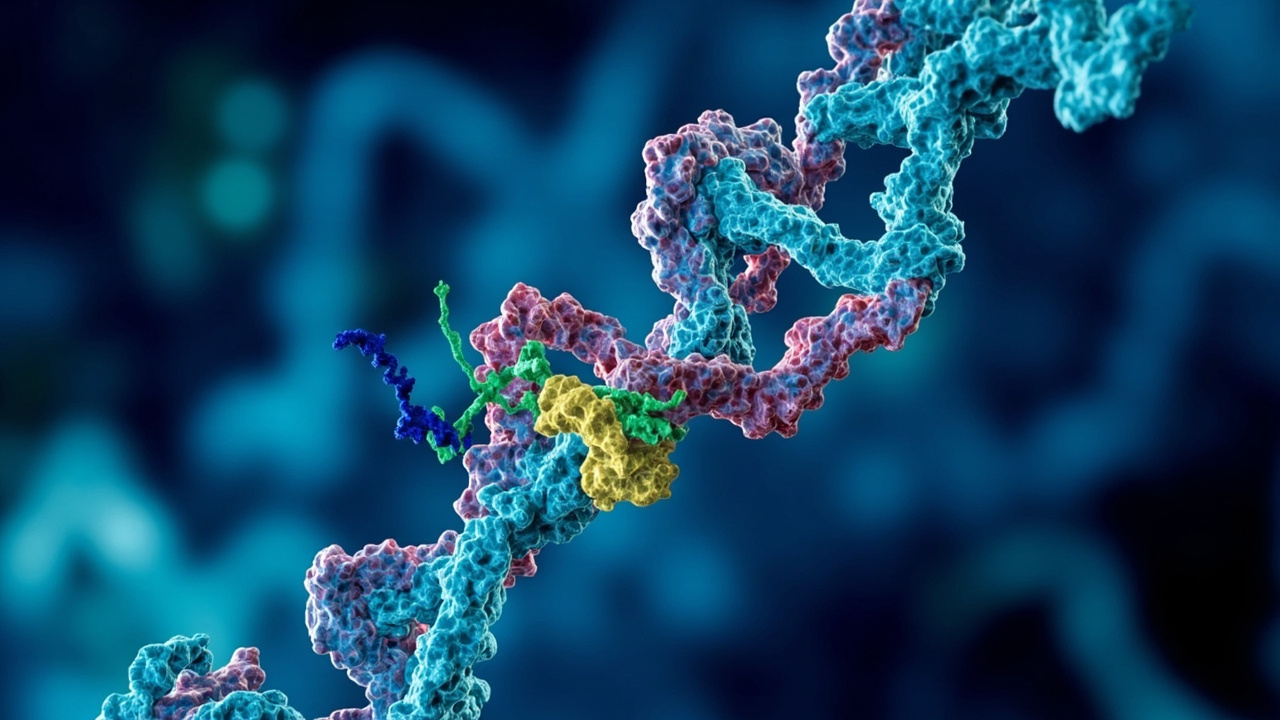
TL;DR: University of Florida chemical engineer Piyush Jain and University of Texas at Austin collaborator David Taylor used cryo-electron microscopy to reveal the atomic shape of a DNA-guided CRISPR tool during RNA editing.
A new blueprint for DNA-guided RNA editing
Piyush Jain continues to innovate major improvements in CRISPR, the genetic engineering tool by which genomes can be edited, according to the University of Florida Department of Chemical Engineering article titled "Jain adds another tool to the CRISPR toolbox."
The October 14, 2026 report, written by Harrem Monkhorst, describes the latest advance as a structural blueprint obtained during the RNA-editing process.
Jain is an associate professor in the University of Florida's Department of Chemical Engineering, working in collaboration with David Taylor, Ph.D., at the University of Texas at Austin.
The team utilized cryo-electron microscopy, also called cryo-EM, to see individual atoms during the editing process.
The resulting work was published recently in Nature Structural and Molecular Biology.
Seeing the underlying structure allows bioengineers to fine-tune DNA-guided CRISPR tools to create safer treatments for complex genetic diseases and design highly accurate viral diagnostics.
That connection between atomic structure and practical use is the central finding reported on October 14, 2026.
According to the Herbert Wertheim College of Engineering version of the same October 14 report, Jain and his collaborators utilized cryo-electron microscopy for this RNA-editing study.
Who led the work
Piyush Jain, Ph.D., leads the University of Florida effort from the Department of Chemical Engineering.
Jain holds the title of Exxon Mobil Gator Alumni Faculty in Chemical Engineering.
The Labroots listing for the CRISPR Virtual Event Series 2026 identifies Piyush K. Jain, PhD, as Shah Rising Star Associate Professor in the Department of Chemical Engineering at the University of Florida.
David Taylor, Ph.D., leads the collaborating effort at the University of Texas at Austin.
Student researchers played a huge role in the work, including graduate students Rodrigo Fregoso Ocampo from the Taylor Lab and Carlos Orosco from the Jain Lab.
Jain credits Taylor's lab at UT Austin with the innovation of using cryo-EM to discover the atomic structure.
Jain recalled that his laboratory completed the initial wet lab work, figured out the sequence, provided that sequence, and purified everything.
The structural analysis was all done at UT Austin.
The UT Austin team obtained not just the overall structure, but the refined structure.
That refined view showed which amino acids in the Cas protein are involved.
It showed where those amino acids are placed.
It showed how those amino acids are interacting with RNA.
It showed how the DNA is folded and interacting in the complex.
What the microscope revealed
The microscopic images revealed that the engineered DNA folds into a tiny, physical hairpin bridge-like structure that guides the CRISPR tool to the target RNA.
Jain likens that structural discovery to creating a blueprint that reveals the exact physical mechanism behind the previously unseen process.
Having revealed the exact structure, scientists are no longer forced to rely on guesswork to improve RNA editing.
The physical map, or blueprint, allows bioengineers to intentionally tweak, scale and fine-tune DNA-guided CRISPR tools.
Those tuned tools are intended to create safer treatments for complex genetic diseases.
Those tuned tools are also intended to design highly accurate viral diagnostics.
Jain and Taylor show, for the first time, the exact atomic shape of the DNA-guided CRISPR apparatus using a cryo-EM system during the RNA editing process.
The initial results of Taylor's structural analysis surprised researchers, who expected the DNA guides to be oriented in a different direction.
The orientation finding underscored why direct atomic imaging mattered for this project.
Instead of inferring the guide position, the team could see individual atoms during the RNA-editing process.
How DNA guides flip the usual CRISPR setup
Typical CRISPR uses tiny strands of RNA to guide the tool to the correct location for the genetic edit.
Like a pair of genetic scissors, it opens both strands of the targeted DNA sequence to introduce the modification.
The correct location for the edits is found using a sort of genetic GPS system.
The work described in the October 14 report involves a flipped system.
In that flipped system, DNA-guided CRISPR uses a single strand of engineered DNA to guide the tool for RNA editing.
Jain's laboratory recently created the world's first DNA-guided CRISPR system and completely redefined how CRISPR technology works.
That earlier innovation was highlighted in Nature Biotechnology.
The new Nature Structural and Molecular Biology work provides the atomic blueprint for the DNA-guided approach to RNA editing.
"We built a synthetic DNA guide with a tiny hairpin loop at the end," Jain said.
That synthetic guide design is the element that folds into the hairpin bridge-like shape.
Jain explained that the loop tricks the CRISPR protein into thinking it is holding its usual target, allowing it to lock onto and cut RNA safely and accurately.
He added that high-resolution cryo-EM imaging revealed exactly how that DNA trick works at an atomic level.
Why a physical map changes engineering
"Engineering and expanding the toolbox we have access to is important," Jain said.
He continued that with the improved DNA-guided CRISPR system and the ability to see the exact underlying structure, his team can design processes and drugs that are more specific, more efficient and more cost-effective.
He described that outcome as the overall goal.
The blueprint concept means that adjustments can be intentional rather than based on guesswork.
Bioengineers can tweak the DNA-guided CRISPR tools.
Bioengineers can scale the DNA-guided CRISPR tools.
Bioengineers can fine-tune the DNA-guided CRISPR tools.
Each of those actions is enabled by knowledge of the exact structure reported in Nature Structural and Molecular Biology.
Jain believes scientists will be better equipped to locate and control disease-causing cellular anomalies by improving CRISPR capabilities and revealing underlying physical processes.
He has often described those anomalies through a metaphor of problems with Xerox copies of DNA.
In that metaphor, DNA inside every cell in the human body is compared to a master instruction guide.
RNA is compared to Xerox copies of that guide.
Metaphors the lab uses to explain CRISPR
Piyush Jain, Ph.D., is described as a master of metaphors for explaining CRISPR, the genetic engineering system by which genomes can be edited.
When asked about the research, he has mentioned Xerox copies, landline telephones, owner's manuals, scissors, dinosaur bones and cupcakes to make complex subject matter more understandable.
He used metaphorical locks and keys to describe improvements to CRISPR that could allow the tool to target virtually any sequence in an organism's DNA.
He often compares the DNA inside every cell in the human body to a master instruction guide.
He often compares RNA to Xerox copies of that guide.
Now there is a hairpin bridge to describe the folded DNA guide observed by cryo-EM.
Jain likens that structural discovery to creating a blueprint that reveals the exact physical mechanism.
The genetic scissors metaphor describes how typical CRISPR opens both strands of targeted DNA.
The genetic GPS metaphor describes how the correct location for edits is found.
How the Florida and Texas labs divided the tasks
The collaboration combined wet laboratory preparation in Florida with high-resolution structural analysis in Texas.
Jain's laboratory figured out the sequence used for the DNA guide.
Jain's laboratory provided that sequence to the Taylor laboratory.
Jain's laboratory purified everything needed for the structural work.
Taylor's laboratory applied cryo-EM to discover the atomic structure.
Taylor's laboratory produced both the overall structure and the refined structure.
The refined structure detailed which amino acids in the Cas protein participate in the complex.
The refined structure detailed the placement of those amino acids.
The refined structure detailed interactions between those amino acids and RNA.
The refined structure detailed folding of the DNA and its interactions in the complex.
Graduate student Carlos Orosco contributed from the Jain Lab.
Graduate student Rodrigo Fregoso Ocampo contributed from the Taylor Lab.
Jain said the productive collaboration between the two groups will continue.
Making DNA and RNA in a chemical engineering lab
Metaphors aside, Jain produces RNA in his laboratory using a device called a nucleic acid synthesizer.
For his research, he orders DNA from a website.
"DNA, it's really just information," he said.
He noted that scientists have figured out how to make DNA outside cells.
He noted that researchers can manufacture DNA in the laboratory.
He explained that researchers can assemble DNA one piece at a time in whatever sequence is requested.
A researcher enters the desired sequence on a website.
The ordered DNA arrives the next day.
Freshly delivered DNA can look like a tiny speck, as if there is nothing in the tube.
A larger amount can look like a flake.
The delivered material carries the sequence that was requested.
That custom DNA order only costs two dollars.
Jain presented that two-dollar example while asking listeners to consider how information-like and manufacturable DNA has become.
Place in the wider CRISPR research conversation
The October 14 University of Florida report places the Jain-Taylor result alongside the laboratory's earlier creation of the world's first DNA-guided CRISPR system highlighted in Nature Biotechnology.
The new step adds atomic structural detail from Nature Structural and Molecular Biology.
Broader community interest in next-generation editing tools, precision in gene editing and use of CRISPR for drug discovery is reflected in the Labroots CRISPR Virtual Event Series 2026 program.
That Labroots program describes a 9th annual event taking place on October 28, 2026, continuing discussion of CRISPR-based editing abilities.
The Labroots agenda lists precision editing among advances in CRISPR technology.
The Labroots agenda lists next-generation detection platforms such as SHERLOCK and DETECTR for rapid, sensitive detection of pathogens and biomarkers among CRISPR diagnostics topics.
The Labroots agenda lists point-of-care applications and field-deployable CRISPR diagnostics for global health.
Piyush K. Jain is listed among speakers for that October 28 program as Shah Rising Star Associate Professor at the University of Florida.
A separate Nature Biotechnology research highlight published October 12, 2026, under the title "Tracing the origins of CRISPR–Cas," discusses work by Yoon and colleagues on viral interference programmable repeat systems described in Science.
That October 12 highlight, written by Dario Ummarino, says understanding evolutionary origins of CRISPR-Cas and other RNA-guided immune systems could reveal new mechanisms for programmable genetic manipulation.
That context shows continued attention to how RNA-guided systems recognize targets, while the Jain-Taylor work focuses specifically on engineered DNA guides for RNA editing and their atomic structure.
The Florida-Texas team reports that direct imaging removed guesswork from that specific engineering challenge.
The reported blueprint covers the DNA guide fold, Cas protein amino acid contacts, and RNA interactions during editing.
What comes next for the toolbox
The Department of Chemical Engineering report states that the collaboration between Jain and Taylor will continue.
The near-term engineering use described in the report is intentional adjustment of DNA-guided CRISPR tools based on the atomic blueprint.
The intended applications named in the report are safer treatments for complex genetic diseases.
Another intended application named in the report is highly accurate viral diagnostics.
The design goals named by Jain are processes and drugs that are more specific.
Additional design goals named by Jain are processes and drugs that are more efficient.
A further design goal named by Jain is processes and drugs that are more cost-effective.
Those goals depend on the improved DNA-guided CRISPR system combined with visibility into its exact underlying structure.
The report does not present the new imaging result as a treatment itself.
It presents the result as a tool and structural guide for future bioengineering of RNA-editing systems.
Sources referenced
- Jain adds another tool to the CRISPR toolbox - Department of Chemical Engineering (https://che.ufl.edu/jain-adds-another-tool-to-the-crispr-toolbox/)