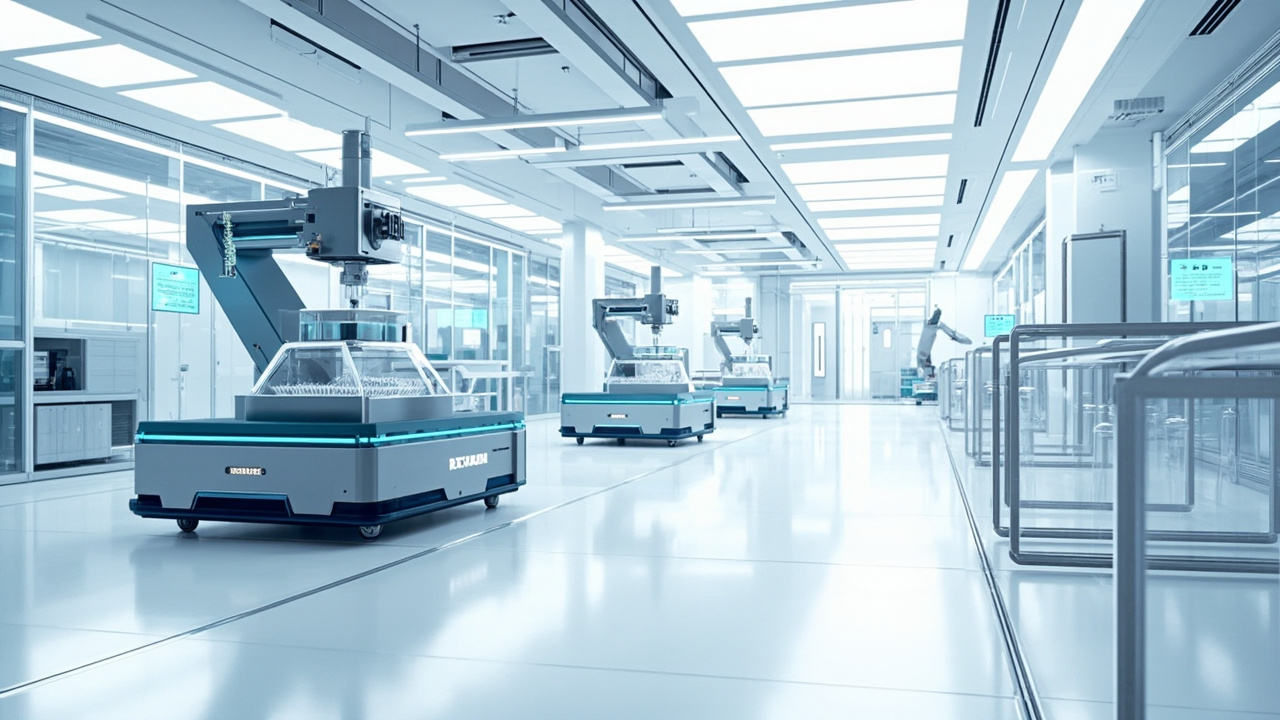
TL;DR: Robots ran the whole protein-engineering loop by themselves and found tougher enzymes.
Self-driving labs built heat-tolerant enzymes on their own. Four autonomous agents designed, built, and tested new glycoside hydrolase variants, learning from each round of robotic experiments and settling on designs at least 12 °C more stable than their starting points after examining less than 2% of the possible landscape, according to the study published in Nature Chemical Engineering.
A protein search run without hands on the bench
Researchers at the University of Wisconsin–Madison built a platform called Self-driving Autonomous Machines for Protein Landscape Exploration, shortened to SAMPLE, to handle protein engineering from idea to test without human intervention, feedback, or subjectivity.
The project was conceived by Jacob T. Rapp, Bennett J. Bremer, and Philip A. Romero, with implementation shared across computation, automation, and biochemistry. The departments listed for the team are Biochemistry and Chemical & Biological Engineering at the University of Wisconsin–Madison in Madison, Wisconsin.
The paper appeared on 11 January 2024. The author manuscript became available in PMC on 11 March 2024, and the final edited form appeared as Nat Chem Eng. 2024 January; 1(1): 97–107, doi:10.1038/s44286-023-00002-4, as documented in the PMC record.
The stated test case was thermal tolerance in glycoside hydrolase enzymes. Four independent SAMPLE agents were deployed on that landscape. Each agent began with broad exploration and then moved toward stable solutions.
All four reached thermostable designs. The improvement was at least 12 °C relative to the initial starting sequences. The search covered less than 2% of the full landscape.
The authors describe SAMPLE as a general-purpose protein engineering platform with potential across biological engineering and synthetic biology. Protein engineering itself is described as having nearly limitless applications across chemistry, energy, and medicine, while creation of new or improved proteins remains slow, labor-intensive, and inefficient.
What SAMPLE actually does
SAMPLE links two parts into one closed loop: an intelligent software agent and a fully automated robotic system.
The intelligent agent learns relationships between protein sequence and function from data. It uses what it has learned to draft new proteins intended to test ideas about the landscape.
Those drafts go directly to robotics. The robotic system synthesizes genes, expresses proteins, and performs biochemical measurements of enzyme activity. Results return to the agent as feedback, sharpening its picture of sequence and function.
That cycle repeats as design–test–learn. Integration between learning and automation is described as seamless, allowing repeated rounds to proceed without a person stepping in to select sequences, move samples, or interpret intermediate data.
As summarized in the PMC record, the agent learns sequence–function relationships, designs new proteins, sends designs to automation for experimental testing, and receives feedback to improve understanding of the system.
Computational work included simulations by Bremer, while Rapp and Bremer implemented the combined experimental and computational system. Rapp performed protein-engineering runs and biochemistry. Rapp and Romero analyzed data and wrote the manuscript, with feedback from Bremer.
How it mimics — and differs from — a human scientist
The study frames human biological research as repeated interaction with a laboratory environment. A researcher forms a hypothesis, designs experiments, carries them out in a wet laboratory, interprets the data, and refines understanding. Repeating that sequence builds knowledge of mechanisms and leads to systems with improved properties and behaviors.
That human sequence can take years because it demands multiple rounds of idea generation and testing. It is described as inefficient, repetitive, and laborious, despite notable achievements in biological engineering and synthetic biology.
SAMPLE is presented as a machine version of the same pattern. The intelligent agent is cast as the actor that takes actions in a laboratory environment and receives data in return. Through repeated interaction, it develops an understanding of the system and learns behaviors aimed at an engineering goal.
Robot scientists and self-driving laboratories are described as combining automated learning, reasoning, and experimentation to speed discovery and design of molecules, materials, and systems. Reported strengths include learning across disparate data sources and data modalities, deciding under uncertainty, operating continuously without breaks, producing highly reproducible data, tracking full metadata, and sharing data in real time.
Those capabilities map directly onto the bottlenecks of manual protein work. Continuous operation removes pauses between rounds. Reproducible measurement with full metadata reduces variation that can obscure sequence–function signals. Decision under uncertainty lets the agent balance trying unfamiliar regions against refining promising ones.
Why proteins were a hard test for autonomy
Self-driving approaches had already been used for gene identification in yeast, new chemical synthesis methodologies, and discovery of new photocatalysts, photovoltaics, adhesive materials, and thin-film materials.
Protein engineering and synthetic biology were viewed as promising but difficult for the same approach. Three obstacles are named: biological phenotypes are complex and nonlinear, genomic search spaces are high-dimensional, and biological experiments involve multiple hands-on processing steps that are error-prone and difficult to automate.
Some automated workflows for synthetic biology already existed, but they required human input and manual sample processing. Because of that hands-on requirement, they were not fully autonomous in operating without human intervention.
SAMPLE was built to remove those touchpoints. Gene synthesis, protein expression, and activity measurement were placed under robotic control and tied to the decision-making agent, so designs could move from computation to physical test and back to computation without manual transfer.
Bayesian optimization is identified as the decision method driving the intelligent agent, allowing it to learn sequence–function relationships and direct the automated laboratory toward informative synthesis and characterization choices, as summarized in the research record indexed by Exa.
Four agents, one landscape, same destination
The demonstration focused on glycoside hydrolase enzymes and heat tolerance. Four SAMPLE agents worked independently on that task.
Early behavior was exploratory. The optimization paths first surveyed broad structure in the landscape rather than immediately committing to a narrow region. That survey phase built an initial picture of how sequence changes related to stability.
The trajectories then converged quickly on highly stable enzymes. Despite differences among agents in search behavior, every agent located thermostable designs. The reported gain was at least 12 °C over the starting sequences. The fraction of the landscape examined was less than 2%.
Differences among the four paths are attributed to experimental measurement noise. In other words, small variations in robotic biochemical readouts nudged individual agents down slightly different routes, yet the outcome was robust across all runs.
The pattern — broad sampling followed by rapid convergence — is presented as active information acquisition. Agents continually refined their picture of the landscape by seeking useful data, then used that refined picture to discover optimized proteins efficiently.
Correspondence for materials is listed as Philip A. Romero at [email protected]. Code and data needed to run that code are listed as accessible at https://doi.org/10.5281/zenodo.10048592, according to the publication record.
What the run shows about autonomous discovery
The central result is not a single enzyme sequence but a mode of work: a closed loop that designed, built, measured, and learned without a person in the loop.
Searching less than 2% of the full space to gain at least 12 °C in stability illustrates the efficiency claim. Exhaustive testing of every combination would be impractical in a high-dimensional sequence space. Selective testing guided by a model that updates after every round reached strong solutions with a small fraction examined.
Robustness across four agents matters because laboratory measurement always carries noise. The fact that distinct trajectories still ended at thermostable enzymes suggests the loop did not depend on a lucky early reading or a single hand-tuned path.
Reproducibility and tracking are part of that argument. Highly reproducible data with full metadata tracking and real-time sharing are listed among the advantages of intelligent robotic systems over manual operation. In a learning loop, consistent data and complete records make each new design decision better grounded than the last.
Context, limits, and provenance
The work was supported in the United States by the Department of Health and Human Services, the National Institute of General Medical Sciences, the National Institutes of Health, and the Department of Energy, including the Great Lakes Bioenergy Research Center and programs in data-driven analysis of protein structure, function, and regulation and biotechnology training.
A patent application on related work was submitted by Rapp, Bremer, and Romero with the Wisconsin Alumni Research Foundation, listed as US patent application no. US20210074377A1. Peer review for the Nature Chemical Engineering paper thanked Melodie Christensen and other anonymous reviewers, and reprints and permissions information is listed as available at www.nature.com/reprints.
The article is open access under a Creative Commons Attribution 4.0 International License, which permits use, sharing, adaptation, distribution, and reproduction with appropriate credit, a link to the license, and indication of changes, with third-party material subject to its own credit line.
Within the limits stated by the authors, SAMPLE is positioned as broadly applicable rather than tied to one enzyme family. The demonstrated task was enhanced thermal tolerance in glycoside hydrolases. The claimed mechanism — an agent that learns sequence–function links and an automated system that synthesizes genes, expresses proteins, and measures activity — does not depend on human selection between rounds.
For chemistry, energy, and medicine, where protein engineering has wide applications, the implication drawn in the paper is faster movement from goal to tested candidate. The human pattern of hypothesis, experiment, measurement, and reinterpretation remains, but the actor performing actions and absorbing feedback is software coupled to robotics rather than a person at the bench.
That shift does not remove the underlying biology challenges. Complex nonlinear phenotypes and high-dimensional search spaces remain. Manual steps remain error-prone when people must perform them. The reported advance is that those steps were placed inside automation and guided by learning that improved with every measurement, allowing four separate runs to start broadly, diverge with noise, and still arrive at enzymes at least 12 °C more stable after seeing less than 2% of possibilities.
Sources referenced
- Self-driving laboratories to autonomously navigate the protein fitness landscape | Nature Chemical Engineering (https://www.nature.com/articles/s44286-023-00002-4)
- Self-driving laboratories to autonomously navigate the protein fitness landscape - PMC (https://pmc.ncbi.nlm.nih.gov/articles/PMC10926838/)