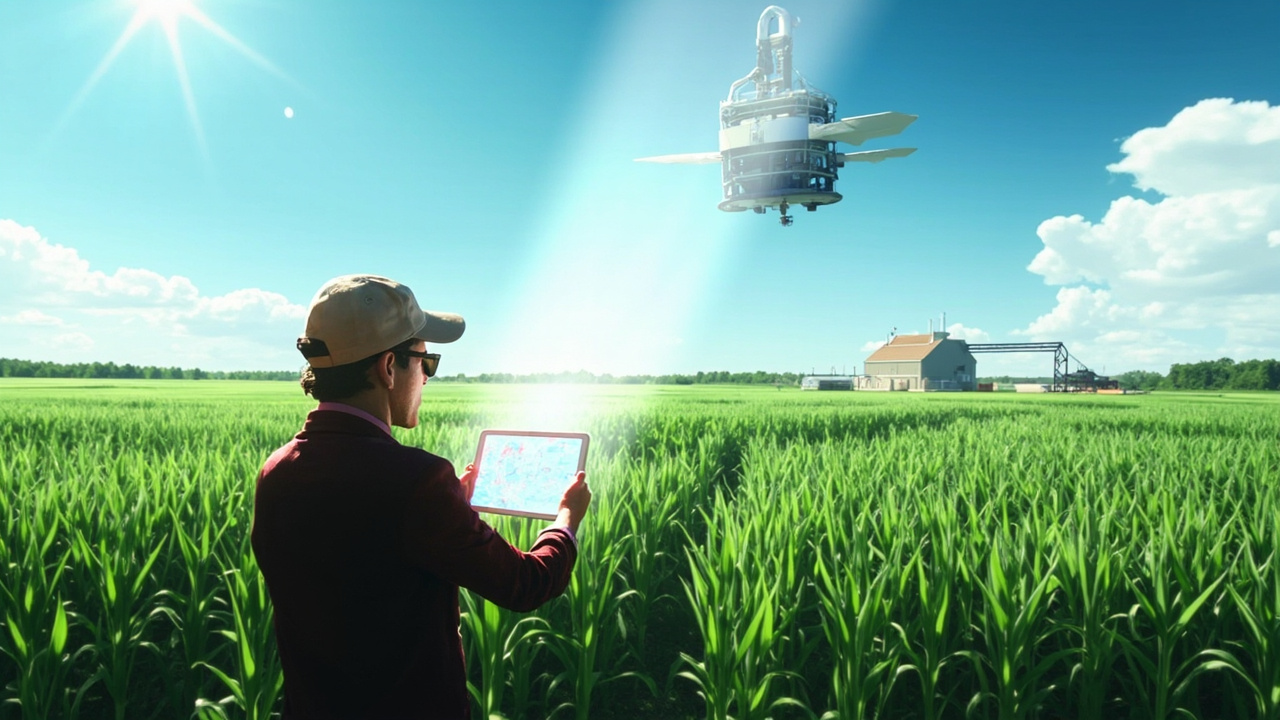
TL;DR: The U.S. Department of Agriculture will test improved satellite imagery, geospatial tools, crop models, and artificial intelligence to improve its crop acreage and yield estimates.
The newest verified development came on Tuesday, Sept. 1, 2026, when Agriculture Secretary Brooke Rollins told attendees at the Farm Progress Show in Boone, Iowa, that USDA is launching a pilot project that leans more heavily on technology to strengthen its closely watched acreage and yield numbers, according to Reuters.
The announcement frames the pilot as a response to criticism about reliability, staffing cuts, and survey participation, and as the first public outline of a broader USDA Data Modernization Plan. Department leaders said the effort will keep farmer polls in place while adding space-based observation and machine analysis, and will try to make it simpler for producers to provide information, according to Reuters and reporting from DTN Progressive Farmer.
What Rollins announced in Boone
Rollins discussed the data modernization plan on stage at the Farm Progress Show in Boone, Iowa, on Sept. 1, after a month-long series of listening sessions with farmers and agricultural groups, according to Reuters.
The secretary said USDA will conduct a pilot to evaluate improved satellite imagery and will work with NASA and other federal agencies across the country to determine how reporting can be made more accurate. The remarks positioned space imagery as a complement to existing survey work, not as an immediate replacement for farmer-provided data.
Reporting from DTN Progressive Farmer, which covered the same Boone appearance, said Rollins also pressed a broader message that conditions for farmers were improving compared with the start of the Trump administration, while acknowledging that work remained. That account quoted Rollins telling the audience that progress was underway but that a long distance still had to be covered.
The technology message was the central news for markets and producers because the National Agricultural Statistics Service reports can move commodity markets, affect the prices farmers receive, and influence federal farm programs, according to Reuters. A second USDA statistical product named in the Boone discussion was the monthly World Agricultural Supply and Demand Estimates, generally known as WASDE, which Rollins said needed to be fixed alongside NASS, according to DTN Progressive Farmer.
Why satellite imagery, geospatial tools and crop models are central
The pilot will use geospatial tools and crop models alongside farmer polls to estimate crop acreage and yields, according to Reuters.
Department leaders described the same approach in greater detail at Boone. Under Secretary for Research, Education and Economics Scott Hutchins said USDA is developing closer work with NASA around a set of newer agency tools, and that those tools could support acreage estimation, crop monitoring, yield analysis, and disaster assessments, according to DTN Progressive Farmer.
Hutchins said the objective is a more continuous understanding of how crops are developing and a faster ability to respond when conditions change, according to that same account. He pointed to recent flooding in Indiana as an example of how quickly corn conditions shifted during the previous month.
The department also said it would explore the use of artificial intelligence and machine learning, according to Reuters. Hutchins discussed incorporating precision-agriculture data and artificial intelligence to improve efficiency across USDA agencies, going beyond statistical reports to include reorganization that would reduce cross-agency redundancy, according to DTN Progressive Farmer.
USDA has attempted to modernize data collection before, and some of those earlier efforts took years to roll out, according to Reuters. Hutchins did not offer a detailed timeline for the new project, but said results would arrive more quickly and that results would be available by the end of the term, according to Reuters and DTN Progressive Farmer.
Making surveys easier to complete
A major stated goal is to make it easier for farmers to share information with USDA, including placing polls online and pre-populating data fields with information USDA already holds, a change officials said could help response rates, according to Reuters. Hutchins presented that point as the under secretary for research, education, and economics.
The burden issue is tied to participation. Surveys have become longer and more redundant over time, and the response level fell from more than 60% a decade ago to under 40% for this year's June Acreage report, according to DTN Progressive Farmer.
Hutchins said the simpler description of the reform is to reduce the burden on farmers in surveys and other channels for supplying data, according to that account. Practical ideas discussed included reuse of information already in USDA systems so producers would not enter the same information repeatedly, redesign of surveys to reduce burden, use of pre-filled data, and creation of phone-based applications for completing surveys.
Under Secretary for Farm Production and Conservation Richard Fordyce added a precision-agriculture element, saying USDA wants acreage reporting to be more farmer-facing by drawing on tools farmers already own, according to DTN Progressive Farmer. Fordyce said USDA has been working with equipment manufacturers on integrating precision-agriculture data into acreage reporting, describing the concept as straightforward but the execution as complex.
Later in the same week, NASS was expected to roll out a new tool called Ag Insights that would let users search more easily for specific agricultural statistics, according to DTN Progressive Farmer. Hutchins presented that search tool as part of integrating data and technology platforms.
The four goals USDA outlined
USDA officials highlighted four goals for the modernization plan during the Boone events, according to DTN Progressive Farmer.
The first goal is to modernize the data reporting experience. That covers shorter, less redundant surveys, online options, phone applications, reuse of existing producer records, and pre-filled fields intended to lift participation.
The second goal is to enhance acreage and yield estimation. That covers greater use of satellite imagery from NASA and other sources, alongside other companies, to support prediction and estimation, plus crop monitoring, yield analysis, and disaster assessment.
The third goal is to integrate data and technology platforms. That covers precision-agriculture data, artificial intelligence, improved efficiency for USDA agencies, reduced cross-agency duplication, and the Ag Insights search tool.
The fourth goal is to expand trust and transparency with producers. That covers clearer communication about methods, closer contact through listening sessions, and an effort to rebuild confidence after complaints about recent estimates.
Together, the four goals keep the traditional farmer poll while adding satellite observation, geospatial analysis, crop models, machine learning, and farm-equipment data as additional inputs.
Why farmers, traders and economists questioned reliability
Farmers have criticized deep staff cuts at USDA, saying the reductions affected data collection and accuracy, according to Reuters. They raised particular questions about the National Agricultural Statistics Service, whose reports are watched closely by markets.
The announcement followed complaints about data reliability from farmers, grain traders, and economists after deep staff cuts and unusually large increases between initial and final estimates of how many acres of corn U.S. farmers planted in 2025, according to Reuters. The department faced scrutiny last year when USDA increased corn acreage by more than 4 million acres after the June Acreage report, according to DTN Progressive Farmer.
Market sensitivity added to the concern. After USDA released its January final estimates, already low grain prices sank more than 5%, at a time when growers were struggling to make money, according to Reuters.
Farmers gathering at the Farm Progress Show said many traditional data-gathering processes were overdue for an update, according to Reuters. Iowa farmer Jeff Mundorf, who attended the show, said some methods had not changed since the 1970s, called the changes big projects for one administration, noted limits on what could be completed, and said he was optimistic.
Rollins herself has acknowledged the loss of confidence and said USDA needs to rebuild farmers' trust in its data, according to Reuters.
A month of listening sessions leading to the pilot
Rollins discussed the plan following a month-long series of listening sessions with farmers and agricultural groups that exposed frustrations with the Trump administration as the farm economy struggled, according to Reuters.
USDA launched its listening sessions in Minnesota on Aug. 4, according to Reuters. Rollins plans to host more sessions through the fall, USDA spokesman Harry Fones told Reuters on Tuesday, Sept. 1.
In those sessions, farmers criticized the reliability of USDA statistics, staffing cuts, and other Trump administration policies affecting the farm economy, according to Reuters. The sessions also became forums for broader grievances. When Rollins visited the Iowa State Fair last month, she faced criticism from cattle producers over Trump's announcement that the United States would increase imports of beef, a move intended to lower consumer prices but which producers feared would hurt cattle prices, according to Reuters.
The political backdrop drew attention because the Cook Political Report, described as a non-partisan election analysis group, shifted Iowa's U.S. Senate race from lean Republican to toss up in the agriculture-dominated Republican stronghold, where farmers struggled with tariffs and rising diesel and fertilizer costs in the wake of the Iran war, according to Reuters. That same account noted that Democrats would need to win all their current seats and pick up four more to take control of the U.S. Senate.
Fertilizer, ethanol and fuel policy points raised at the show
At Boone, Rollins also spotlighted areas where she said the farm economy had improved and pointed to administration actions intended to support production and demand, according to DTN Progressive Farmer.
Those actions included efforts to boost domestic production of fertilizer, increase exports of some commodities such as ethanol, and an administration decision on Monday to require refiners to pick up the full reallocation of 1.7 billion gallons tied to small-refinery exemptions from the Renewable Fuel Standard, according to that account.
The fuel-policy detail mattered to the audience because ethanol demand affects corn use, and corn acreage and yield estimates were at the center of the data debate. The broader economic message did not change the technical focus of the day, which remained on statistics collection at NASS and related reports.
What happens next for NASS, WASDE and producers
USDA leaders did not present a detailed calendar for the pilot beyond the commitment to deliver results by the end of the term, according to Reuters.
Near-term steps described at Boone included continued listening sessions through the fall, development of daily work with NASA on satellite tools, review and redesign of surveys, identification of burden-reduction changes that can be put into practice quickly, exploration of artificial intelligence and machine learning, talks with manufacturers on precision-agriculture data, and release of the Ag Insights search tool, according to Reuters and DTN Progressive Farmer.
For producers, the practical test will be whether surveys become shorter, whether online and phone options expand, whether pre-filled information reduces repeat entry, and whether acreage and yield numbers show smaller revisions between early and final reports. For traders and economists, the test will be whether additional satellite, geospatial, model, and equipment data narrow the surprises that moved markets after recent reports.
The department's framing keeps farmer responses as a foundation while testing whether imagery and computation can improve timeliness, accuracy, and usefulness. The outcome of that test, officials said, will determine how quickly newer methods move from pilot evaluation into regular production of federal crop statistics.
Sources cited in this article include Reuters reporting from Boone, Iowa, republished by CNA and MarketScreener, and DTN Progressive Farmer coverage of the Farm Progress Show announcements.