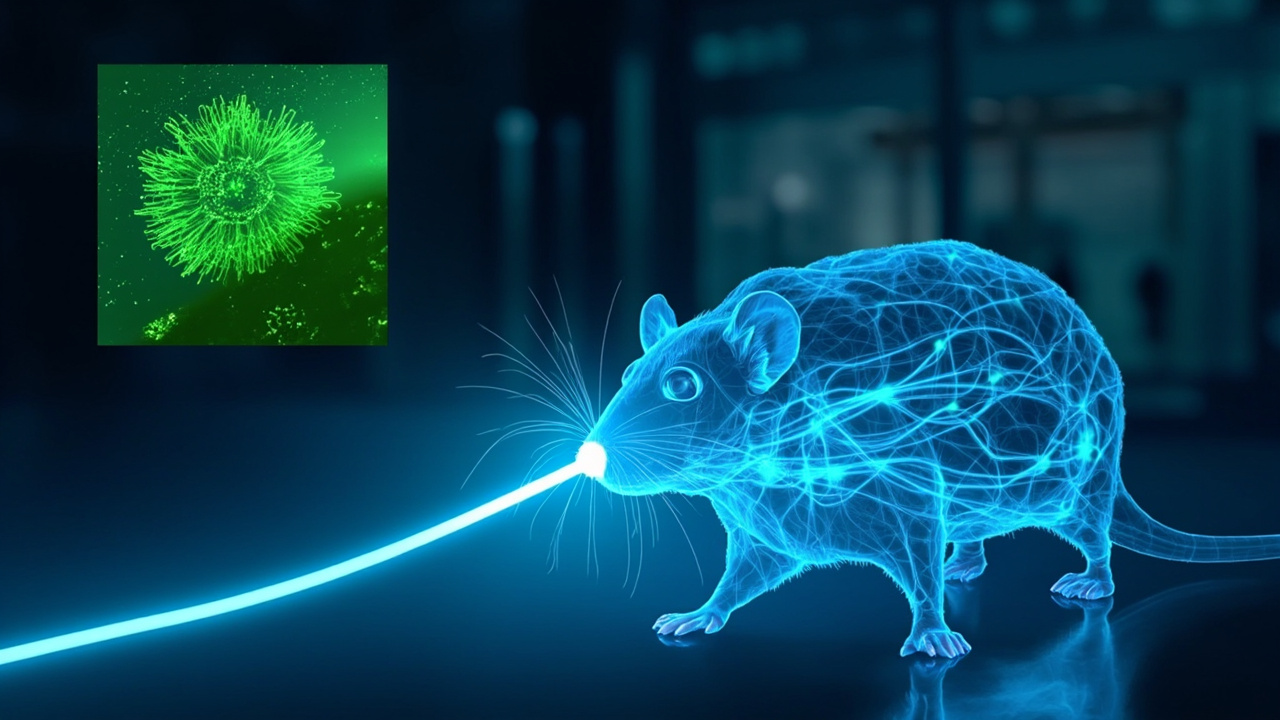
TL;DR: On 5 October 2026, the Nobel Assembly at Karolinska Institutet awarded the Nobel Prize in Physiology or Medicine jointly to Karl Deisseroth, Peter Hegemann and Georg Nagel for discoveries concerning light-gated ion channels and optogenetics.
The decision, announced in Stockholm on Monday 5 October 2026, recognizes a light-controlled method for switching nerve-cell activity on and off in the living brain, according to NobelPrize.org. The laureates share a prize amount of 12 million Swedish kronor equally.
American Karl Deisseroth is affiliated with the Howard Hughes Medical Institute and Stanford University in the United States. Germans Peter Hegemann and Georg Nagel are affiliated with Humboldt University of Berlin and the University of Würzburg, respectively, according to NobelPrize.org. Reuters reported their ages on announcement day as Deisseroth, 54; Hegemann, 71; and Nagel, 73.
The formal citation is “for their discoveries concerning light-gated ion channels and optogenetics,” according to NobelPrize.org. Reuters summarized the achievement as developing optogenetics, a technique that uses light to control individual nerve cells in the brain.
Winners named in Stockholm
The Nobel Assembly at Karolinska Institutet decided the joint award to the three researchers, according to NobelPrize.org. The announcement was made at the Karolinska Institute in Stockholm, kicking off Nobels week, according to The Associated Press reporting carried by NPR.
Thomas Perlmann, secretary of the medicine committee, announced the laureates, according to Karolinska Institutet reporting and NobelPrize.org. Thomas Perlmann was able to reach all three winners by telephone on Monday, according to The Associated Press.
Photographs of Karl Deisseroth, Peter Hegemann and Georg Nagel were shown on screen as the award was announced during a press conference at the Nobel Forum at Karolinska Institutet in Stockholm on 5 October 2026, according to The Associated Press. The Nobel committee wrote on X that the method is now being used in laboratories around the world to reveal the brain's mysteries, according to The Associated Press.
Prize money this year is 12 million Swedish kronor, about $1.2 million, according to The Associated Press. Nature reported the same total as 12 million Swedish kronor, equivalent to US$1.2 million, shared equally among the three winners. NobelPrize.org states that the 12 million Swedish kronor will be shared equally between the laureates.
Why optogenetics won
The 2026 prize was awarded for optogenetics — a method that makes it possible to show how nerve cells shape memories, feelings and behaviours in the living brain, according to NobelPrize.org. The Assembly said Peter Hegemann and Georg Nagel discovered a remarkable protein, channelrhodopsin, in a single-celled alga, while Karl Deisseroth transformed the protein into a light-controlled switch for nerve cells.
The laureates laid the foundation of a new era in neuroscience, according to NobelPrize.org. The method makes it possible to switch on, or off, the activity of individual nerve cells in a living brain, according to Reuters and NobelPrize.org.
Per Svenningsson, Chair of the Nobel Committee for Physiology or Medicine, said optogenetics provides new opportunities for mapping the brain, according to NobelPrize.org. His statement was quoted in the press release announcing the prize:
“Optogenetics provides opportunities for mapping the brain in a way that we could once only dream of,” says Per Svenningsson, Chair of the Nobel Committee for Physiology or Medicine, according to NobelPrize.org.
Nature reported that the technique has transformed how neuroscientists study the brain by offering a way to test cause and effect. After being on many scientists’ shortlists for years, optogenetics was recognized by the 2026 prize, according to Nature.
From brain maps with gaps to tests of cause and effect
How the brain governs feelings, behaviours and bodily functions has long been a mystery, according to NobelPrize.org. In the 20th century, researchers began to investigate which areas of the brain affect which functions, but the methods used meant they could not prove causal relationships, according to NobelPrize.org.
The image of the brain developed with those earlier methods was like a sketch map, full of question marks and unknowns, according to NobelPrize.org. That situation is now changing with optogenetics, according to NobelPrize.org.
Neuroscientists aim to unpick the brain’s many roles in governing feelings, behaviours and bodily functions, according to Nature. To understand how the brain works and how its cells mediate different behaviours, scientists require an approach that can perturb the system with high precision, according to Nature.
Nature described the advance as a light-controlled switch that allowed neuroscientists to alter specific cell types in the neural circuits of living brains using genetics. The technology soon came to be known as optogenetics and revolutionized neuroscience, according to Nature.
Rui Costa, president and chief executive of the Allen Institute in Seattle, Washington, said the prizewinners’ work fundamentally changed how neuroscience is conducted and influenced fields beyond neuroscience while opening new therapeutic possibilities, according to Nature. Costa said he first met Deisseroth 23 years ago and described Deisseroth as already thinking deeply about controlling specific neurons to understand and alter behaviour, according to Nature. Costa also pointed to Deisseroth’s commitment to sharing tools and reagents at scale as equally transformative, according to Nature.
A light-seeking alga provided the starting part
It began with Peter Hegemann’s curiosity about Chlamydomonas, a single-celled alga able to swim toward a light source, according to NobelPrize.org. Hegemann wondered how that movement toward light was possible, according to NobelPrize.org.
In the early 2000s, Hegemann and Georg Nagel discovered channelrhodopsin, an algal protein with unusual properties found on the surface of the cell, according to NobelPrize.org. When illuminated by blue light, a channel opens through the protein, according to NobelPrize.org. Charged ions then flow into the cell, creating an electrical impulse, according to NobelPrize.org.
They found that regardless of which cell they put the protein in, those cells became light sensitive, according to NobelPrize.org. NobelPrize.org states the same result in its prize summary: Hegemann and Nagel found that cells receiving the protein became light sensitive.
Nature identified the organism as the alga Chlamydomonas reinhardtii, which is able to swim toward a light source. Working together in the early 2000s, Hegemann and Nagel discovered light-sensitive proteins called channelrhodopsin 1, 2 in that alga, according to Nature. In response to blue light, the protein opens to allow charged molecules to flood into cells, creating a tiny electrical charge, according to Nature.
Alexander Gottschalk, a neuroscientist at Goethe University Frankfurt in Germany, said optogenetics provided an easy and precise way to define which cells should become responsive, according to Nature. Gottschalk said many people in the field had expected the award for several rounds before 2026, according to Nature. Gottschalk has worked with all three winners and said he knows Nagel best, describing Nagel as humble and modest and saying the prize was well deserved, according to Nature.
Deisseroth turned an algal protein into a neuron switch
Karl Deisseroth introduced the gene for channelrhodopsin into nerve cells from rats, according to NobelPrize.org. By illuminating the cells with blue light, he was able to trigger a nerve signal, according to NobelPrize.org. He published this breakthrough in 2005, according to NobelPrize.org. Two years later, he made the light-controlled switch work in the brains of living mice, according to NobelPrize.org.
Nature reported that Deisseroth and colleagues inserted the gene encoding channelrhodopsin into neurons of rodents and found that it caused the cells to fire and communicate with other neurons. The key publication cited by Nature is Boyden, Zhang, Bamberg, Nagel and Deisseroth in Nature Neuroscience in 2005. Earlier foundational publications cited by Nature are Nagel and colleagues in Science in 2002 and in Proceedings of the National Academy of Sciences of the USA in 2003.
Deisseroth described the capability in practical terms at Stanford University on announcement day, according to Nature. He said researchers use light to turn on or off individual cells, or even types of cells or connections from one part of the brain to another, according to Nature. He said the switching can be done with millisecond precision in real time during behaviour and cognition, allowing researchers to see what matters for brain function and to map function and dysfunction precisely, according to Nature. He called the work a confluence of engineering and medicine, according to Nature.
Deisseroth said the Nobel call was a complete surprise, according to Nature. He told a press conference held by Stanford University that he had been working late, consistent with describing himself as a night owl, and was lying down and starting to drift off to sleep when his telephone rang at his bedside, according to Nature. He said there were about 30 seconds when he had trouble forming words and described the news as exciting, overwhelming and delightful, according to Nature.
What the tool does inside living circuits
This method for controlling nerve signals with light is now called optogenetics and has rapidly gained global impact, according to NobelPrize.org. Using optogenetics, researchers have been able to reveal neural circuits governing specific memories, feelings and behaviours relevant for neurological and psychiatric disorders, according to NobelPrize.org.
In clinical medicine, researchers are using the method in attempts to restore sight in people with visual impairment, according to NobelPrize.org. Nature reported that insights from optogenetic tools have helped researchers better understand healthy brain function and conditions such as depression, schizophrenia, Parkinson’s and Alzheimer’s.
Optogenetics has fundamentally altered understanding of the brain, according to NobelPrize.org. New discoveries continue every day, helping address how the brain works, according to NobelPrize.org.
Reuters listed three outline points for the award: an American and two Germans won the medicine prize, the trio was selected for work on optogenetics, and optogenetics uses light to control nerve cells in the brain. Reuters identified the awarding body as the Nobel Assembly of Sweden’s Karolinska Institutet and gave the announcement location as Stockholm on 5 October 2026.
Careers behind the discovery
Karl Deisseroth was born in 1971 and earned a Ph.D. in 1998 and an M.D. in 2000 from Stanford University, according to NobelPrize.org. He is D.H. Chen Professor and Professor of Bioengineering and of Psychiatry and Behavioral Sciences at the Howard Hughes Medical Institute and Stanford University, according to NobelPrize.org. The Associated Press described him as a professor in the Departments of Bioengineering and Psychiatry at Stanford University and noted that he had earlier received a Japan Prize trophy in the Life Sciences field during a presentation ceremony in Tokyo on 13 April 2023.
Peter Hegemann was born in 1954 and earned a Ph.D. in 1984 at the Max Planck Institute for Biochemistry in Martinsried, Germany, according to NobelPrize.org. He is Hertie Senior Professor of Neuroscience at Humboldt University of Berlin, according to NobelPrize.org. The discoveries awarded the prize were made at the Max Planck Institute for Biochemistry in Martinsried, according to NobelPrize.org.
Georg Nagel was born in 1953 and earned a Ph.D. in 1988 at the University of Frankfurt, according to NobelPrize.org. He is Professor of Molecular Plant Physiology in the Department for Molecular Plant Physiology and Biophysics – Botany I at the University of Würzburg, according to NobelPrize.org. The discoveries awarded the prize were made at the Max Planck Institute for Biophysics in Frankfurt, according to NobelPrize.org.
The Nobel Assembly, founded in 1977, is the body at Karolinska Institutet that awards the Nobel Prize in Physiology or Medicine, according to NobelPrize.org. Further information was listed at nobelprize.org, with press contacts Pernilla Witte and Secretary-General Thomas Perlmann, according to NobelPrize.org.
Sources referenced
- Press release: Nobel Prize in Physiology or Medicine 2026 - NobelPrize.org (https://www.nobelprize.org/prizes/medicine/2026/press-release/)
- American Deisseroth and Germans Hegemann and Nagel win 2026 Nobel medicine prize | Reuters (https://www.reuters.com/business/healthcare-pharmaceuticals/deisseroth-hegemann-nagelwin-2026-nobel-medicine-prize-2026-10-05/)