TL;DR: Stanford neuroscientists replaced most of a mouse's missing cortex with lab-grown human neurons that grew, wired into the animal, and partly restored behavior.
Stanford University researchers genetically removed most of the cortex and neighboring hippocampus in newborn mice and then filled the empty space with human cortical organoid tissue, creating animals whose outer brain was dominated by human cells, according to Science News and MIT Technology Review. The work was reported September 16, 2026 in Nature in a paper titled Developmental xenocortication using human-derived organoids in mice, according to the Nature abstract and Science News.
The senior leader was Stanford neuroscientist Sergiu Pașca, according to Science News and MIT Technology Review. The first author was Konstantin Kaganovsky and colleagues, according to the Nature abstract listing. The team called the resulting animals xenocortical mice, according to MIT Technology Review and the Nature abstract.
Why organoids needed a living host
The idea of growing miniature brain structures in laboratory dishes emerged in the early 2010s, when researchers in Austria showed that stem cells could self-organize into three-dimensional tissue resembling aspects of the developing human brain, according to Science News. These small clusters, called organoids, lacked the connections and sensory inputs of a living brain, according to Science News.
Organoids adopt three-dimensional tissue structure and contain various specialized cells, which makes them a better model than dissociated cells lying flat on a culture dish, according to Researchers swap in human brain cells for a mouse's cortex - Ars Technica. Yet organoids remain limited because they are not hooked up to a circulatory system and lack immune cells moving through them, according to Researchers swap in human brain cells for a mouse's cortex - Ars Technica.
That limitation is especially acute for brain studies, where specialized structures exchange information and maintain long-range connections, according to Researchers swap in human brain cells for a mouse's cortex - Ars Technica. An organoid may offer little help for disease that affects communication among multiple brain regions, according to Researchers swap in human brain cells for a mouse's cortex - Ars Technica.
One earlier alternative was to implant human neural stem cells into another species, where they generally integrate and actively signal to neighbors, according to Researchers swap in human brain cells for a mouse's cortex - Ars Technica. When those human cells are surrounded by normally functioning host neurons, it is unclear how much can be learned from them, according to Researchers swap in human brain cells for a mouse's cortex - Ars Technica.
Pașca and colleagues had previously developed a way to transplant human organoids into newborn rats in 2022, eventually getting human cells to make up about one-third of one side of the rat cortex, according to Science News. Rat neurons mature faster than human counterparts, which capped how much the human tissue could develop in that rodent model, according to Science News.
In that 2022 rat work, the researchers placed organoids in rats to understand Timothy syndrome, a rare genetic condition that causes severe heart problems and autism among other symptoms, according to the Science report Human neurons flourish in mouse brains. By transplanting brain tissue made from skin cells of young people with the condition, the team found the molecular defect that seems to cause the disorder and identified a potential treatment now entering clinical safety tests, according to the Science report Human neurons flourish in mouse brains.
Brain organoids are typically made from mature human skin cells reprogrammed into an immature state and guided to develop into various brain cell types, according to the Science report Human neurons flourish in mouse brains. Those blobs have shown an ability to self-organize and mimic some features of a developing brain, according to the Science report Human neurons flourish in mouse brains. When confined to dishes, however, they do not allow study of how disease or damage affects behavior, according to the Science report Human neurons flourish in mouse brains.
Pașca noted that limitation is important for conditions such as autism, which is diagnosed based on behavioral symptoms, or epilepsy, which requires evidence of seizures from a brain scan, according to the Science report Human neurons flourish in mouse brains. His stated goal was to make aspects of human brain development and function accessible for investigation so therapeutics could be developed, according to Science News.
How mice were engineered without a cortex
Pașca and colleagues bred mice genetically engineered to develop without most of their cortex and neighboring hippocampus, two structures involved in movement, learning and memory that together account for about half of total brain volume, according to Science News. Another description said the animals were bioengineered to lack 98% of the cortical and hippocampal tissue found in ordinary mice, according to Reuters in Scientists transplant lab-grown human brain tissue into mice.
The Stanford team chose the cortex as the portion to delete, although the cortex handles many complex features such as decision-making and memory, according to Researchers swap in human brain cells for a mouse's cortex - Ars Technica. Researchers found a gene active in almost all cortical cells and used it to drive deletion of a key gene needed to separate chromosomes during cell division, according to Researchers swap in human brain cells for a mouse's cortex - Ars Technica.
Despite killing off most cells that should form mature cortex and cutting brain volume in half, the mice could survive, according to Researchers swap in human brain cells for a mouse's cortex - Ars Technica. The researchers had to eliminate most other pups to ensure the cortex-free mice got enough nursing, according to Researchers swap in human brain cells for a mouse's cortex - Ars Technica. They left them with mothers to nurse longer and then provided very high-calorie food, according to Researchers swap in human brain cells for a mouse's cortex - Ars Technica. Those steps allowed nearly full survival of mice without much cortex, according to Researchers swap in human brain cells for a mouse's cortex - Ars Technica.
The mice were also immunocompromised to avoid an immune reaction to human cells, a condition described as less of an issue in a sterile mouse care facility, according to Researchers swap in human brain cells for a mouse's cortex - Ars Technica. The transplantation platform used a genetic strategy to effectively deplete glutamatergic neurons from mouse neocortex and hippocampus, described as apallial, and to neonatally engraft the cortical cavity with human stem-cell-derived cortical organoids, according to the Nature abstract.
Although the resulting animals showed some behavioral defects, they were described as surprisingly functional, according to Science News. Pașca said one surprising discovery was that mice lacking brain tissue seemed fairly normal, walking around and squeaking, but showing memory problems, according to MIT Technology Review. In a maze test, they could not remember what parts they had explored, according to MIT Technology Review.
How human tissue was implanted
When the animals were 2 days old, researchers placed about 100,000 cells of human-derived tissue in the cavity where mouse brain tissue should have been, according to the Science report Human neurons flourish in mouse brains. The human brain organoids were grown from healthy donor stem cells, according to Science News.
The cavernous space created by missing tissue could then accommodate those organoids, according to Science News. Transplantation successfully took hold in 25 of 29 attempts, according to Science News. A slightly different framing said a bit over 85 percent of implanted animals successfully incorporated graft tissue, according to Researchers swap in human brain cells for a mouse's cortex - Ars Technica.
Those grafts went on to contribute 92 percent of cells found in the cortex of these animals, according to Researchers swap in human brain cells for a mouse's cortex - Ars Technica. Over the next three months, human tissue expanded nearly fivefold in volume in these mice, ultimately filling more than 90 percent of the cortex, according to Science News. Another account said human cells placed in these animals will divide, will grow, and within a few weeks to a few months they will take most of that space, according to MIT Technology Review.
Images showed transplanted human brain tissue extending nerve fibers into a mouse brain that lacks a cerebral cortex, credited to the S. Pașca lab at Stanford University, according to Nature in Human brain cells transplanted into mice. A map of estimated nerve-fiber pathways outlined the graft with dashed white lines and color indicating main fiber direction, green top to bottom, red front to back, and blue side to side, according to Reuters in Scientists transplant lab-grown human brain tissue into mice.
What kinds of human cells grew
Once in place, the human cells formed all major types of neurons known to be present in the cortex, according to Researchers swap in human brain cells for a mouse's cortex - Ars Technica. The tissue developed into a range of cell types, including rare neurons that proved nearly impossible to generate in a dish, according to Science News.
The grafts generated a diversity of human cortical cell types, including layer 5 extratelencephalic projection neurons, according to the Nature abstract. In transplanted brain tissue, researchers glimpsed a type of rare human neuron that had not been successfully grown in a dish before and that may hold clues to treating a certain type of dementia, according to the Science report Human neurons flourish in mouse brains.
The tissue lacked some features of a mature cortex, including its characteristic layers, yet still wired extensively into the mouse nervous system, according to Science News. There was some indication of local organization, in that specific cell types that form within distinct layers of a normal cortex tended to be near each other, according to Researchers swap in human brain cells for a mouse's cortex - Ars Technica. There was no sign of those distinct layers being formed, suggesting larger-scale organization was lacking, according to Researchers swap in human brain cells for a mouse's cortex - Ars Technica.
How human neurons wired into mice
Human cortical neurons integrated with the mouse nervous system, according to the Nature abstract. The human cells also formed some long-distance connections, as evidenced by processes detected as far away as the spinal cord, according to Researchers swap in human brain cells for a mouse's cortex - Ars Technica. These cells grew and connected to brains and spinal cords of rodents, according to the Science report Human neurons flourish in mouse brains.
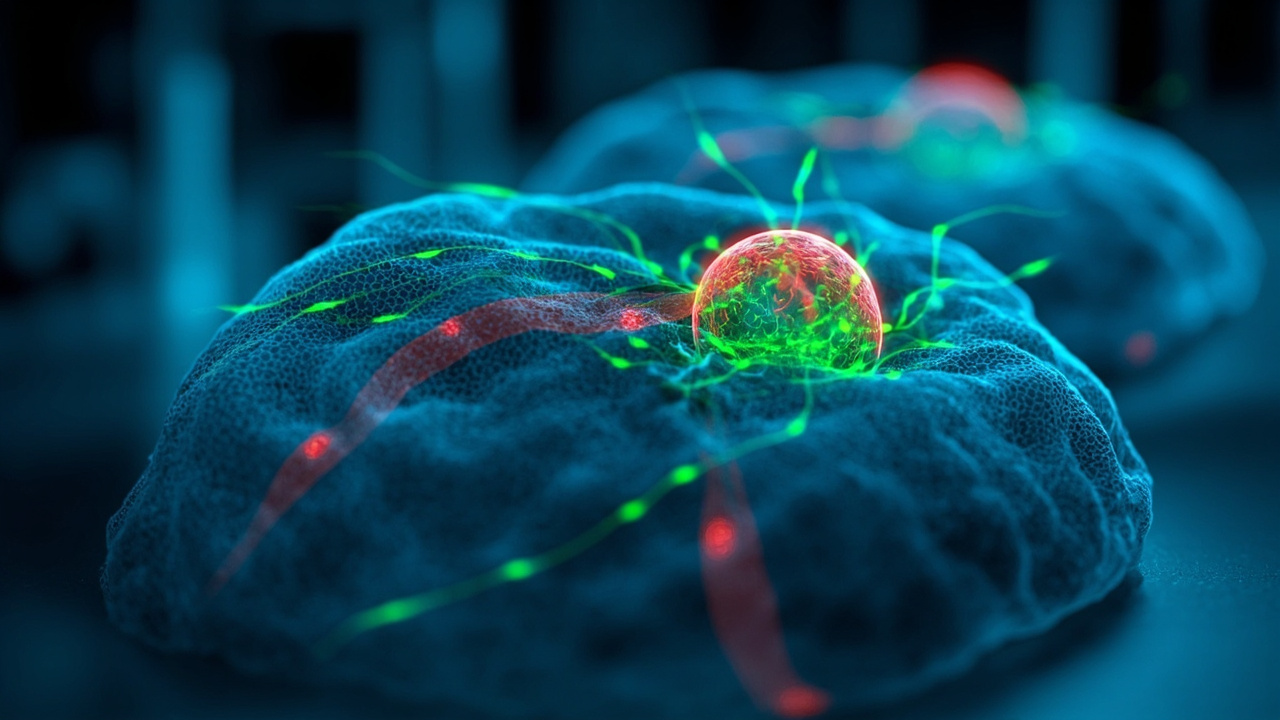
After transplant, growing human neurons shown in green and red formed connections with surrounding mouse brain shown in blue, according to Science News. The human cells extend processes shown in green into mouse portions of the brain, according to Researchers swap in human brain cells for a mouse's cortex - Ars Technica.
In vivo cortical graft-wide calcium imaging and electrophysiological analyses revealed patterns of organized activity resembling developing circuits, according to the Nature abstract. Neurons engaged in synchronized activity spikes, suggesting a degree of coordination, according to Researchers swap in human brain cells for a mouse's cortex - Ars Technica.
The extent was described as the most extensive integration ever, with lab-grown organoids wiring into mice missing a key part of their brain, according to Nature in Human brain cells transplanted into mice. Transplanted tissue could grow to occupy most vacant space and wire into animals' nervous systems, according to Nature in Human brain cells transplanted into mice.
What behavior showed
Behavioral analyses of apallial and xenocortical mice revealed broadly preserved locomotion alongside selective differences in limb coordination and altered organization of spontaneous behavior, according to the Nature abstract. Multiple cameras tracked a mouse as it wandered around a small arena, while a computer charted position and speed, according to MIT Technology Review.
Having a disorganized human replacement cortex was better than having no cortex at all, but not as good as having a normally structured one, according to Researchers swap in human brain cells for a mouse's cortex - Ars Technica. Researchers set them loose in an area with video monitoring, according to Researchers swap in human brain cells for a mouse's cortex - Ars Technica.
On tests of fine motor control and memory, grafted mice performed somewhere between mice with intact brains and those lacking a cortex, according to Science News. Mice with added human cells performed better on a maze test than mice lacking tissue, indicating human tissue played some role in cognition, according to MIT Technology Review. Nearly half brain volume had been replaced with human cells in the animals watched in a small arena, according to MIT Technology Review.
How injury was modeled for cerebral palsy
The platform enabled behavioral readouts in a model of injury to developing human cortical cells, according to the Nature abstract. Researchers used the mice to model cerebral palsy, a disability caused by damage to the developing brain, according to Science News. They subjected grafted animals to oxygen deprivation, according to Science News.
Afterward, human tissue showed cellular signs of injury, and mice developed problems with gait and limb coordination, features also seen in people with the disability, according to Science News. Pașca said this could be used down the line to test many therapeutics being considered for cerebral palsy, according to Science News.
He plans to study frontotemporal dementia and genetic forms of autism with the mice, using organoids made from patient-derived cells affected by those conditions, according to Science News. Pașca believes xenocortical mice could be useful in studying brain injuries, according to MIT Technology Review. The mice will be useful for applications difficult to capture in other systems, according to the Science report Human neurons flourish in mouse brains.
Ethics debate and primate red line
The technique was called certainly bold by H. Isaac Chen, a neurosurgeon at the University of Pennsylvania who studies brain organoids but was not involved, according to Science News. The extent of humanization raises questions about ethical boundaries, Chen noted, but Pașca had gone to unusual lengths to grapple with those concerns, according to Science News.
Pașca consulted an outside panel led by Insoo Hyun, a bioethicist at the National University of Singapore Yong Loo Lin School of Medicine, according to Science News. Hyun acknowledged the model raises legitimate questions about where to draw the ethical line, but said there is little evidence these mice crossed it, according to Science News.
Hyun said what matters is not how much human tissue an animal contains, but what that tissue enables it to do, according to Science News. From a secular ethical point of view, he said, it boils down to cognitive capacity, and so far these mice do not seem to have gained obvious extra brainpower, according to Science News.
Last year, Pașca convened ethics experts to study implications of neural organoid technology, including odds an animal could develop human consciousness and risk that organoid therapy clinics might offer scam treatments, according to MIT Technology Review. Carsten Charlesworth, a scientist in a different Stanford lab not involved in the research, called the report a dramatic demonstration of the combined power of genetic engineering and stem-cell technology to reshape biology, according to MIT Technology Review.
Charlesworth said what was most remarkable was the extent to which human neural tissue introduced after birth grew and connected across a species barrier, according to MIT Technology Review. He said as these technologies advance, they will increasingly force challenges to traditional assumptions, according to MIT Technology Review.
For now, Pașca said he was not concerned rodents had human cognitive capacities because brains are relatively tiny and evolutionary distance between man and mouse is great, according to MIT Technology Review. He said this type of experiment should not be carried out on higher species because they could end up with large volumes of functioning human brain tissue, potentially blurring cognitive boundaries, according to MIT Technology Review. He specifically cautioned against adding human brain organoids to a monkey engineered to lack a cortex, according to MIT Technology Review. He described doing this experiment in a primate as a very clear red line and said he did not think it was justified at this point in any way, according to MIT Technology Review.
Sources referenced
- These mice have human (nerve cells) on the brain - Science News (https://www.sciencenews.org/article/mice-brain-human-organoid-cells)