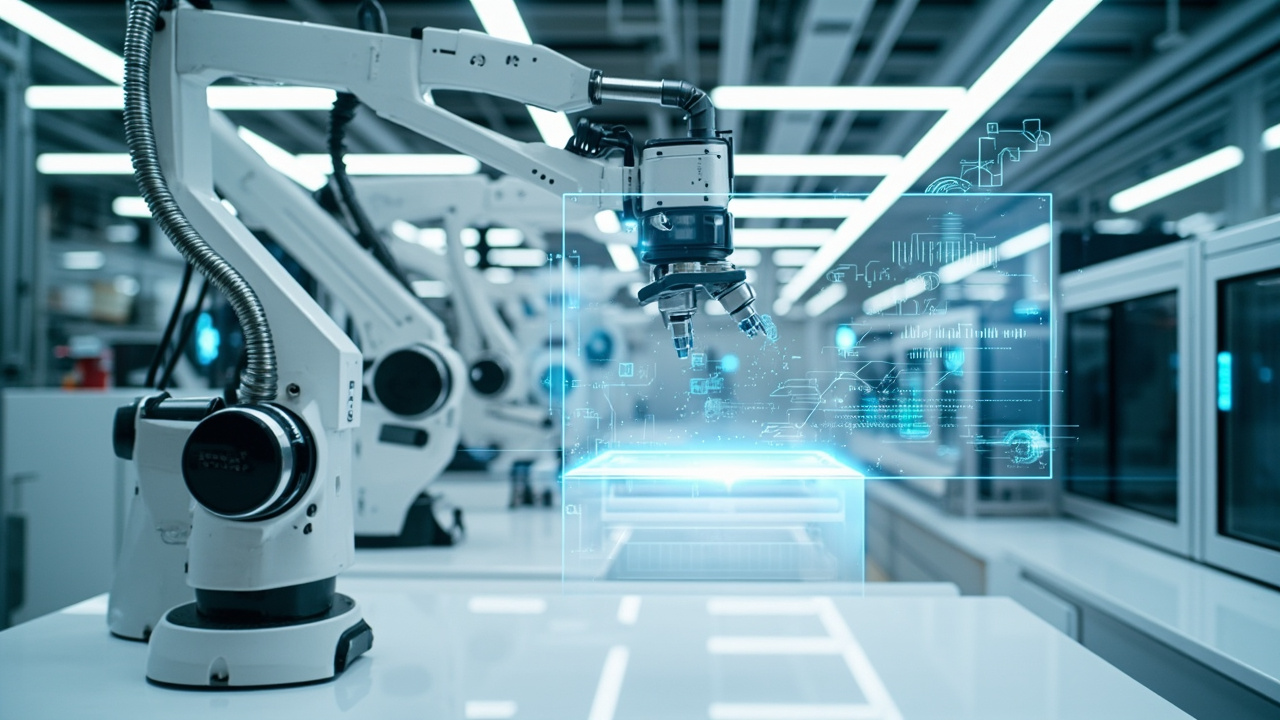
TL;DR: Anthropic opened a research preview on Aug. 27, 2026, for a shared Model Hardware Standard that lets AI agents operate microscopes, liquid handlers, robotic arms and other programmable instruments in parallel.
Anthropic moves agents from screens to lab benches
Anthropic introduced a research preview of the Model Hardware Standard, described as a common specification for allowing AI agents to operate physical equipment safely, according to the company's announcement titled Previewing the Model Hardware Standard. The preview was made available Aug. 27, 2026, to an initial set of scientific laboratories and advanced manufacturers. The system is designed to let one agent direct several laboratory and manufacturing instruments at the same time.
The supported equipment cited by the company includes microscopes, liquid handlers and robotic arms. Example uses range from routine drug-discovery experiments to laser calibration on a quantum computer. The work began as a collaboration between Anthropic and HHMI Janelia Research Campus, according to that same company announcement.
Ars Technica reported on Aug. 27, 2026, in its article titled Anthropic's new hardware standard lets AI agents control the physical world, that the effort centers on standardized drivers intended to let agents interface with and control different devices through a common layer. CNBC described the concept in its report titled Anthropic pushes into physical world with new standard to help AI agents operate machines as comparable to a USB-C cord for transmitting information between machines.
Why lab setup takes so long today
Setting up and integrating hardware in a laboratory or manufacturing facility often requires weeks, if not months, according to Anthropic. Most devices do not communicate with one another. Specialists are commonly needed to build custom integrations for each combination of instruments.
Anthropic said the Model Hardware Standard reduces that integration work to hours or minutes. The change matters for facilities where rotating laser beams, microscopes, cameras and many other components must coordinate, a challenge highlighted by Ars Technica in describing an experiment on memory formation in the brain.
That experiment, observed at HHMI Janelia Research Campus in Ashburn, Virginia, involved neuroscientist Arco Bast, according to Ars Technica. Anthropic Technical Staffer Alek Kemeny said Bast had developed an interface that allowed the components to coordinate through a common interface. Kemeny recalled thinking the approach might allow AI to run many science experiments, as reported by Ars Technica.
What the standard actually does
The Model Hardware Standard introduces a standardized driver, software that translates between a computer operating system and a hardware device, according to Anthropic. The driver uses a small set of primitives, including commands described as "read" and "write." Anthropic gave the examples of getting a temperature and setting a temperature.
Each device becomes discoverable in a standard format. Devices and agents can therefore find one another and communicate across networks without a custom translator program in between, according to the company announcement. Ars Technica similarly described the design as a common interface and common format for data sharing between devices.
The driver also supplies information that may not be evident from code alone. Anthropic cited the weight of a robot arm as an example, noting that such a characteristic is important for safe manipulation. Much of that information has previously been stored in paper manuals, on a user's computer, or held as tacit knowledge, according to the company.
How agents learn an unfamiliar device
To capture physical context, the driver contains tags that allow a user to enter information directly in natural language, according to Anthropic. Users can write the information themselves or answer questions from an agent that interviews them about the hardware setup.
From those tags, the driver automatically produces a reference file describing general characteristics of a device, according to the company. The file covers what the device can measure, what can be adjusted, and what safety limits will be enforced. That file supplies what the agent needs to operate the device.
Ars Technica described this part as a standardized tagging system for real-world constraints. In addition to physical characteristics such as weight and range of a robot arm, the tags cover adjustable parameters, measurement options and enforced safety limits, according to that reporting.
Three ways an agent issues commands
After devices are connected and described, the agent needs control paths. Anthropic lists three mechanisms for the Model Hardware Standard: MCP, the command line interface, and code files that expose APIs. Working together, those paths support orchestration across multiple devices through a single line of code, according to the company.
Devices can also be controlled directly in real time through command-line prompts and API code files without AI involvement, according to Ars Technica. When linked to an AI model through the Model Context Protocol, scientists can interact with devices using natural language, that report added.
Anthropic said the standard works with any device that has a programmable interface. It is model-agnostic, and any agent harness can access it using standard protocols such as the Model Context Protocol, according to the company announcement. CNBC also described the system as model-agnostic, meaning users are not limited to Anthropic's Claude family of models.
What round-the-clock operation looks like
Once an agent can control devices, it receives operating data from each instrument and supervises work at a higher level, according to Anthropic. The agent can sequence steps across instruments, monitor results and adjust parameters as conditions change in real time.
Anthropic said agents can reason through each step in an experiment, update parameters in real time, and in some cases recover from hardware errors without intervention. That capability supports autonomous, round-the-clock experiments and workflows, according to the company.
For long-running tasks, or operations that must run faster than online reasoning allows, the agent can chain driver commands from one or more devices into code files, according to Anthropic. The devices then carry out operations themselves without requiring the agent to reason at every step. Ars Technica similarly reported that models can sequence steps across instruments by writing API scripts and adjusting them as conditions require.
Laser, microscope and robot arm examples
Anthropic said testing showed Claude interacting with experiments and hardware in an exploratory way, similar to a scientist. In one case observed by the company, Claude adjusted a laser, viewed the result through a camera to assess how the adjustment moved the beam, and repeated the process to understand the sequence of events.
Claude then packaged what it learned into code files, writing a deterministic script that aligned the laser without reasoning at each step, allowing the entire process to run as a single command, according to Anthropic. Ars Technica gave a parallel example in which a model adjusts a laser, checks the outcome with a separate camera, and repeats the cycle to calibrate the system automatically.
Another example involves microscopy. Anthropic's materials describe a model focusing a microscope, analyzing results, deciding which portion needs further observation, and moving the microscope to the relevant section to continue the experiment, according to Ars Technica. In video material released with the announcement, Claude worked out how to have a robotic arm pick up an aluminum can without having been specifically trained on the required steps, that report added.
Who gets access first
The research preview is open to a first group of scientific research laboratories and advanced manufacturers, according to Anthropic. The company said it is sharing an early version with partners across science, robotics, electronics and manufacturing.
Ars Technica named Amazon Web Services (Strands Robots), Hugging Face (LeRobot), Raspberry Pi, Automata and Universal Robots as participants during the preview period. The purpose is to collaborate on safety evaluations and develop best practices for AI systems operating physical equipment before the standard becomes open source, according to Anthropic.
Anthropic said interested organizations can apply for access to the research preview. The company plans to eventually make the Model Hardware Standard open source and agent-agnostic for integrating AI and physical systems, according to Ars Technica. CNBC reported that open-sourcing would allow any device manufacturer in any industry to adopt the specification.
Safety work before open source
Anthropic said it will work with trusted partners to determine how to maximize safety before general availability, a point emphasized in WIRED's report titled This Is How Anthropic Thinks AI Agents Should Navigate the Physical World. That report noted potential misuse issues, including development of biological weapons, while stating that guardrails built into AI models themselves should prevent use for harmful ends.
Alek Kemeny, a quantum physicist who co-led the development, said the motivation was accelerating science, according to WIRED. "The impetus is wanting to accelerate science," Kemeny said.
Kemeny also asked how capabilities for literature review and data analysis could be extended to experimental work, according to that same WIRED report. Jonah Cool, an experimental biologist who worked on the standard at Anthropic, said configuring scientific equipment and coordinating it with other hardware typically requires serious expertise, according to WIRED.
Elizabeth Kelly, head of beneficial deployments at Anthropic, told CNBC the project was built for science to demonstrate the promise of AI while also offering benefits for enterprise and industry. CNBC reported her statement as: "We built this for science to sort of show the promise of AI, but there's also huge benefits here for enterprise and for industry,"
Connection to earlier Anthropic protocol
Anthropic open-sourced another standard called the Model Context Protocol in 2024, which makes it easier to connect AI agents and data sources, according to CNBC. The Model Hardware Standard builds on that idea by extending agent access to physical systems.
Reuters reported on Aug. 27, 2026, in its article titled Anthropic unveils new framework allowing AI agents to operate physical devices, that the Model Hardware Standard enables agents to operate laboratory and manufacturing instruments such as microscopes and robotic arms in tandem. That report placed the tasks in the same range described by Anthropic, from drug-discovery experiments to laser calibration on a quantum computer.
In early testing with scientific partners over the past year, Anthropic said it saw the system reduce device-integration time and allow faster iteration in experimental settings, according to Ars Technica. In promotional video material, Kemeny said faster hypothesis testing could speed creation of general technologies, that report added.
What remains limited in the preview
The announcement describes a research preview, not a finished open release. Only selected organizations in science, robotics and manufacturing have access at this stage. Safety evaluations and operating practices are still being developed with those partners.
The specification itself does not require AI. Direct command-line and API control remain available, according to Ars Technica. The AI-linked functions — natural-language interaction, step-by-step reasoning, live parameter updates and in some cases recovery from hardware errors — apply when the hardware layer is paired with a model through protocols such as the Model Context Protocol, according to Anthropic.
For laboratories evaluating the preview, the practical change is narrower integration work and a machine-readable description of each instrument. For manufacturers, the same driver approach applies to programmable production equipment. Broader availability depends on completion of the preview evaluation and the planned open-source release, which had not occurred as of Aug. 27, 2026, according to the sources for this article.
Sources referenced
- Previewing the Model Hardware Standard \ Anthropic (https://www.anthropic.com/news/model-hardware-standard-research-preview)