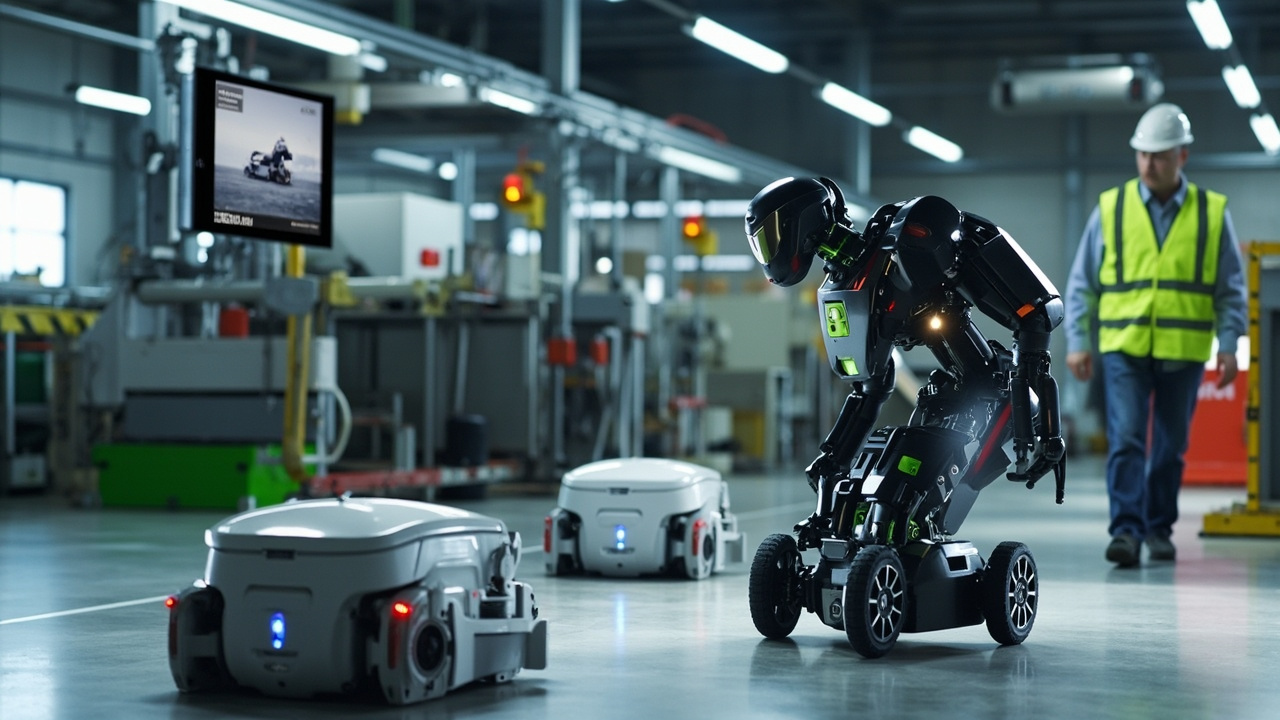
TL;DR: Nvidia is treating safety engineering — not just faster chips or smarter models — as the unlock for robotaxis and humanoid robots working near people, through its Halos full-stack safety platform.
Nvidia's answer: make safety travel with the machine
Nvidia's multitrillion-dollar market capitalization is fueled in large part by investors bullish on AI data centers, but the chipmaker has also bet billions of dollars on physical AI such as robotics and self-driving cars, according to Ars Technica. The core of that second bet is a full-stack safety system that other companies can build upon to lower the risk that their machines harm nearby people.
That system is called Halos. Nvidia launched Halos in 2025 with hardware and software tools to help developers add guardrails in self-driving cars and other autonomous vehicles. In June 2026, the company announced Halos for Robotics to extend the same architecture to autonomous mobile robots in warehouses, humanoid robots walking inside factories, and even surgical robots.
The timing reflects a judgment inside Nvidia about what now limits deployment. Amit Goel, head of robotics ecosystem and edge computing at Nvidia, told Ars Technica that AI models and robot hardware have become increasingly capable, and safety was viewed as the likely next bottleneck. Halos for Robotics was launched, in his description, to unlock the capability of those systems.
The robotics expansion arrives as Nvidia describes physical AI as a major business line. CEO Jensen Huang said during an appearance on the All-In Podcast in March 2026 that the physical AI business was already driving nearly $10 billion in annual revenue, according to Ars Technica. Huang began highlighting physical AI as the company's second-most important growth category in 2025.
From cars to warehouses, factories and hospitals
Halos did not begin as a humanoid program. Nvidia first aimed the system at autonomous vehicles, offering tools for building controls that limit the risks of autonomous systems, according to certi.news. The June 2026 robotics announcement applied that experience to a much wider set of machines and risks.
The goal is safe deployment in places full of people and changing conditions. Examples described in the reporting include autonomous mobile robots in warehouses, humanoids moving through factory aisles, and surgical robots. That breadth matters because safety means different things for different machines, a point Nvidia managers emphasized in interviews.
Nvidia also framed Halos as part of a larger shift in industrial safety. Traditional factory safety is often rigid and rule-based: fence off the robot and stop work if a person crosses a marked line, according to reporting summarized by Crypto Briefing. Halos is pitched instead as adaptive, AI-driven safety intended to keep machines productive in messy environments while still meeting safety standards.
The commercial context is large. Barclays estimates that revenue from humanoid robots could reach $200 billion by 2035, as cited by Crypto Briefing. ABI Research projects an installed base of 49 million level 3-5 autonomous vehicles by 2035, while Omdia estimates roughly 60 million industrial robots will be deployed between 2026 and 2035, according to DailySynapse. Nvidia says safety must extend beyond a one-time predeployment check as machines operate on roads, in factories, in warehouses and in other shared spaces.
What Halos actually contains
Think of Halos as a safety kit rather than a single chip or app. It bundles AI compute, functional-safety hardware and software, sensor integration, simulation and validation tools, and help with certification, according to Crypto Briefing.
The hardware foundation starts with the Nvidia IGX Thor computing module for robotics and industrial applications. That module includes an independent processor dedicated to safety-related workloads. Goel told Ars Technica that in physical AI, the functional system and the safety system need to run on the same silicon.
On the software side, the Halos operating system was designed to enable constant monitoring of every hardware block and every software library to spot failures quickly, Goel explained to Ars Technica. The system also isolates safety-critical computing workloads to avoid potential interference from other software.
A third element is the Nvidia Holoscan Sensor Bridge. It connects sensor data with safety-related processing in a way that can identify corrupted data. That bridge function can be embedded in individual hardware components, like a microcontroller or Field Programmable Gate Array.
The package also includes Nvidia simulations for testing robots in virtual environments, plus an inspection-lab program that lets robotics companies and partners get quick feedback on safety artifacts that arise during development. The lab concept is central to Nvidia's pitch: developers do not only test once, but iterate with structured safety feedback.
Crypto Briefing added detail on the named software pieces: Halos Core, Halos OS, and the Halos Outside-In Safety Blueprint. The blueprint is open source, allowing developers to inspect and build on it rather than treating safety logic as a sealed box.
Why robotics safety is harder than car safety
Adapting Halos from autonomous vehicles to robotics required rethinking safety definitions, according to Ars Technica. The definition of functional safety for autonomous driving generally remains the same across different automotive companies and countries, Goel explained. Robotics is far more varied.
A robotic vacuum cleaning a hallway has very different safety considerations than a robotic forklift handling heavy payloads at a warehouse loading dock. The risks, stopping distances, payloads, human proximity and consequences of failure all change. Nvidia therefore rebuilt much of the platform to be programmable, giving developers hooks to define custom safety functions without breaking the underlying infrastructure.
Goel told Ars Technica that the team had to reimagine and do foundational work to provide flexibility to developers while retaining control over the stack. Giving flexibility, he said, can come at the cost of losing some control.
The need for custom functions also reflects where robots work. Factories, warehouses and hospitals are unstructured environments where layouts change and people or carts can appear from any direction. A robot moving down an aisle at six miles per hour may not see blind spots or what is coming around a corner. In such cases, the described behavior is to slow almost to a halt before the turn because the robot cannot know what will appear ahead.
That example illustrates Nvidia's point that safety does not depend on the AI model alone. According to certi.news, reliable operation depends on sensors, compute, software isolation, and virtual and field testing together.
Agility's Digit 5: the first Halos humanoid
The U.S. startup Agility Robotics was first to incorporate Nvidia Halos into its latest Digit 5 humanoid robot, according to Ars Technica. Digit 5 is designed to work safely near people without requiring isolated workstations or physical barriers.
The Nvidia system helped Agility bring relevant safety sensors and hardware inside the robot itself. Earlier Digit operations had also relied on external sensors placed around the robot's work cell to ensure safety. Moving safety onboard means the robot carries its protections between tasks and locations.
Goel told Ars Technica that the robot is now literally unchained, with safety traveling wherever the machine goes. In his account, Digit units can operate across a factory or warehouse without setting up new infrastructure every time they start a new task.
Deployment planning is already tied to large logistics and manufacturing names. Crypto Briefing reported that deployments using Halos OS in Digit are in the works for Amazon, GXO, Schaeffler and Toyota Motor Manufacturing Canada. Those names match Agility's previously disclosed customer sites for Digit testing and operations.
Agility's role is also architectural. Inside Deep Tech reporting noted that Agility is the first launch partner for Halos for Robotics on IGX Thor and Halos Core, tying safe operation around people and assets to a move from pilots to industrial scale. The company unveiled Digit 5 on Sept. 15, 2026 as a machine engineered for cooperative work near people.
Boston Dynamics, KION and LG join the early wave
Boston Dynamics, based in Massachusetts, has also been an early partner in the Nvidia Halos safety accreditation program, according to Ars Technica. The focus is building a safety platform that encompasses Spot robot dogs, wheeled Stretch robots with a large robotic arm, and Atlas humanoid robots that could start deploying in automotive factories.
Other early participants broaden the picture beyond humanoids. Germany's KION Group uses autonomous forklifts and mobile robots, while South Korea's LG is developing a humanoid robot based on Nvidia's Isaac GROOT foundation model, according to certi.news. The combination shows Nvidia aiming Halos at both legged machines and more established warehouse vehicles.
Independent assessment is part of that push. The Halos AI Systems Inspection Lab is described as the first ANAB-accredited program focused on where AI safety and functional safety meet in physical applications, according to Crypto Briefing. The lab works with established certification names including TÜV Rheinland and UL Solutions.
DailySynapse separately reported that TÜV SÜD certified Nvidia's Automotive Product Lifecycle software process and DriveOS 6.0 to ISO 26262 ASIL D, while ANAB accredited the Halos AI Systems Inspection Lab as an ISO/IEC 17020 inspection body. Those credentials matter because, as humanoids enter shared workspaces, certification bodies and safety rules will help shape which platforms enterprises accept.
Nvidia's investments and research partnerships
Nvidia has invested directly in multiple robotics companies, including humanoid startups Agility Robotics and Figure AI, along with companies developing robotics foundation models, according to Ars Technica. It has also partnered with China's Unitree to provide an open humanoid robot reference design for researchers.
The partnerships extend to large industrial robot makers. Teknalyze reported that collaborations with ABB Robotics, FANUC, KUKA and YASKAWA focus on integrating Nvidia technologies into industrial robots, with the aim of developing and deploying physical AI at scale in manufacturing and logistics.
On the software side, Nvidia's open models including Cosmos and Isaac GR00T provide foundations for robot learning and reasoning, according to Teknalyze. That open-model strategy runs alongside the safety stack: one side helps robots learn tasks, the other helps constrain them safely.
Amazon Web Services has also built on the same direction. Amazon launched a Physical AI Toolchain on AWS as an open-source stack integrated with the Nvidia physical AI stack, covering synthetic data, training, simulation and deployment for industrial automation, mobility and humanoids. The AWS move underscores how cloud training and edge safety are being linked in current deployments.
The robotaxi half of the bet
While Halos for Robotics drew attention in June 2026, Nvidia's vehicle work continued in parallel. The company unveiled Halos for Robotics on June 22, 2026 at the Automate conference in Chicago, according to Crypto Briefing. That same month it advanced vehicle intelligence with Alpamayo 2 Super, a 32-billion-parameter reasoning-based vision language action model for Level 4 robotaxi development, according to Teknalyze.
Alpamayo 2 Super extends the Alpamayo family of open AI models with larger parameter scale for reasoning and spatial understanding in complex driving scenarios. It supports reasoning, auto-labeling, scene understanding and knowledge distillation into smaller models. Nvidia also introduced AlpaGym, a high-throughput closed-loop reinforcement learning framework, and Cosmos-Dreams, a generative world model for simulating rare and long-tail driving scenarios.
Nvidia's DRIVE Hyperion platform provides the deployment foundation for Level 4-ready robotaxi fleets. It integrates DRIVE AGX in-vehicle compute, Halos OS as the software foundation for safety functions, and a multimodal sensor suite for environmental perception, according to Teknalyze. In June 2026, Nvidia expanded that ecosystem to include automakers, autonomous-vehicle software partners and ride-hailing providers.
The in-vehicle configuration is sensor-heavy. DRIVE Hyperion 10 combines dual Nvidia DRIVE AGX Thor systems-on-a-chip with 14 high-definition cameras, nine radars, three lidars and 12 ultrasonics for real-time 360-degree sensor fusion, supported by redundant compute and sensing for fail-operational driving, according to DailySynapse.
Collaborations named around robotaxis include Foxconn, VinFast, Uber and HUMAIN, with deployment interest covering Taiwan, Southeast Asia and the Middle East, according to Teknalyze. DailySynapse listed a broader ecosystem across development and production including Uber, May Mobility, Bolt, Lyft, Grab, WeRide, Waymo, Wayve, Nissan, Zoox, Momenta, Pony.ai, Waabi, Mercedes-Benz, Stellantis, Lucid, Nuro, Hyundai Motor, Kia, Geely and Zeekr.
How training, simulation and safety fit together
Nvidia describes its robotaxi platform as a three-computer solution covering AI model training, simulation and validation, and real-time in-vehicle computing, according to DailySynapse. DGX systems train driving models, the Alpamayo portfolio provides reasoning vision-language-action models and datasets, and reinforcement-learning tools adapt models to specific vehicles and deployment needs.
For testing, Omniverse NuRec reconstructs real-world driving scenarios from sensor data, while Cosmos generates physically based variations across driving behavior, traffic, weather, lighting and sensor conditions. Nvidia said adding meta-action and chain-of-thought reasoning data improved trajectory prediction accuracy, cutting minimum average displacement error by 43%, from 2.08 to 1.18.
The same simulation-first logic applies to robots. Halos includes virtual-environment testing alongside the inspection-lab program, allowing partners to probe edge cases before hardware encounters them. Nvidia frames physical AI safety as a layered discipline covering hardware, software, AI behavior, operating environments and the full deployment lifecycle, according to DailySynapse.
Four shifts shape that model: dynamic environments that require context-aware systems, AI-specific assurance, ongoing updates and changing conditions after deployment, and validation at scale through simulation, synthetic data and scenario reconstruction. The message is that certification cannot be a single predeployment gate when models update and environments change.
What remains unproven
The expansion of Halos does not prove that humanoid robots have become independent workers able to handle any task, according to certi.news. Success will depend on developers defining suitable safety functions for each environment and verifying performance outside test conditions.
That caution applies to both humanoids and robotaxis. A programmable safety layer helps machines move from fixed stations to multiple tasks in different locations, but each new aisle, factory, hospital corridor or city street introduces new blind spots and interaction patterns. The platform's value will be tested in operating hours, not announcements.
Investors and enterprise buyers are watching three signals, according to Crypto Briefing: how quickly the Agility deployments with Amazon, GXO, Schaeffler and Toyota Motor Manufacturing Canada move from planned to operating at scale; whether other humanoid and mobile-robot makers sign on after Agility; and how regulators and certification bodies treat humanoids in shared workspaces. Nvidia's early accreditation work suggests it wants a seat at that rulemaking table before rules harden.
Sources referenced
- Ars Technica - Nvidia's big bet on physical AI aims for safer robotaxis, humanoid robots (https://arstechnica.com/ai/2026/10/nvidias-big-bet-on-physical-ai-aims-for-safer-robotaxis-humanoid-robots/)
- certi.news - Nvidia Expands Halos System to Improve the Safety of Autonomous Robots (https://certi.news/en/article/15663)