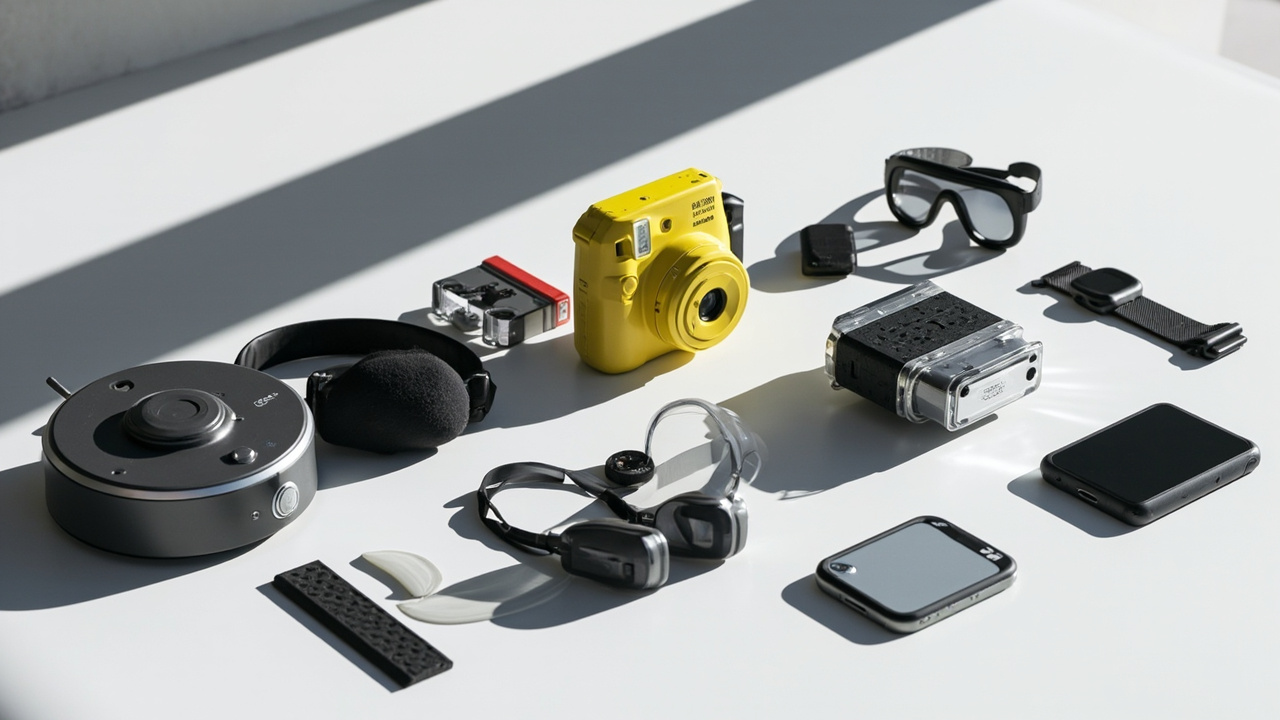
TL;DR: August 2026 delivered finished, orderable gadgets — from Garmin's brighter Fenix 9 to Xiaomi's three-day Redmi phone — ahead of September's iPhone and IFA rush.
August is often described as quiet for consumer hardware, but the month ending August 31, 2026, closed with an unusually dense set of completed launches. According to Gizmodo's roundup titled "The Best Gadgets of August 2026," shoppers saw voice-directed vacuums, character-themed cameras, second-generation noise-canceling headphones, tougher action cameras, and budget-friendly augmented-reality glasses all land in the same four-week window. According to The Verge's reporting in its Gadgets Archive for August 2026, the same period added a brighter Garmin flagship, a long-endurance Redmi phone, a skating desktop robot, swim-tracking goggles, and new storage and television options.
Together, the releases show where U.S. buyers are getting immediate value: longer battery life, hands-free control, better outdoor visibility, and lower prices for previously expensive categories.
Why August mattered before September
September was expected to bring new iPhones, a wave of smart-home hardware tied to IFA 2026, and likely new smart glasses around Meta Connect. That context, laid out in "The Best Gadgets of August 2026," helps explain why August looked like a warm-up.
In practice, August was not a placeholder. Retail discounts were already active, including a Labor Day price cut on an indoor game system, while several flagship wearables and phones were announced with firm prices and order dates. For readers tracking U.S. science and technology news, the practical point is simple: many August products were available to order in August, not merely previewed for later.
Robot vacuums learned to take directions
Matic adds voice-pointed cleaning
The Matic robot vacuum was not entirely new hardware in August, but it earned renewed attention because of software. According to "The Best Gadgets of August 2026," a feature called Matic Cues lets owners direct spot cleaning by pointing and saying "clean this."
The same report says owners can also say "Hey Matic, follow me" to have the machine follow a person to a location to be shown debris or a spill. The company says the commands function across more than 70 languages and dialects. Voice control itself is familiar, but the report notes that this style of pointed, conversational command has rarely appeared in robot vacuums.
Outdoor robots leaned on LiDAR
Outdoor cleanup also advanced. According to "The Best Gadgets of August 2026," the Dreame A3 AWD Pro robotic lawnmower uses LiDAR for navigation and mapping.
LiDAR allows the dock to be placed without depending on a satellite signal, a practical benefit for homeowners with weak reception. The report says lawn mapping performed better than most rivals, although object avoidance remained imperfect and behavior could be conservative.
Cameras got playful and tougher
Polaroid Go goes Pokémon
Instant photography received one of the month's most visible tie-ins. According to "The Best Gadgets of August 2026," Polaroid introduced a Polaroid x Pokémon collection built around its Polaroid Go cameras.
The lineup included a bright yellow Pikachu version with a strap styled like Pikachu's tail, a blue, pink and white Sylveon edition, and a red-and-white Poké Ball version. A Poké Ball-shaped case was offered for an additional $25. The report also highlights a Poké Ball shutter button, underscoring that the changes were cosmetic and accessory-driven rather than a new imaging platform.
Insta360 X6 refines the 360 formula
For action-video users, the month's major arrival was the Insta360 X6 360 camera. According to "The Best Gadgets of August 2026," the $700 camera earned strong marks for low-light quality, battery life, and gimbal modes.
The report, citing Gizmodo staff reporter Kyle Barr, says the camera does not reinvent the category but executes existing ideas better than competitors. It points to an improved 1/1.1-inch sensor and 360-video processing as reasons the camera stands out at the top of the action-camera market.
Headphones and earbuds split by price
Bose QuietComfort Headphones, 2nd Gen
Bose updated its mainstream over-ear line without using the Ultra name. According to "The Best Gadgets of August 2026," the QuietComfort Headphones (2nd Gen) are priced at $360.
The report praises active noise cancellation as formidable, describes sound quality as good, and emphasizes comfort. It singles out the two-tone Dewdrop Mint color and a slightly smaller fit than the QuietComfort Headphones Ultra (2nd Gen). For buyers prioritizing noise cancellation near that price, the report presents the model as worth consideration.
The same launch was also noted in broader August product coverage, where improved noise cancellation, an option to turn cancellation off in the app, Bose Immersive Audio with Cinema Mode for clearer dialogue, and two-way USB-C audio for calls and charging-while-listening were described as the headline changes.
CMF Clip Pro brings a dial on the case
Open-style listening continued to expand. According to "The Best Gadgets of August 2026," the CMF Clip Pro is the company's first clip-style wireless earbud set, priced at $99.
Audio and comfort are described as decent for the price, but the distinctive detail is a Smart Dial on the charging case for playback and volume control. The report characterizes the dial as quirky rather than transformative, while arguing that the low price makes the set defensible as a second pair, particularly for exercise.
AR glasses pushed sharper value
Augmented-reality eyewear remained competitive in August. According to "The Best Gadgets of August 2026," the Viture Pro 2, priced at $299, combined sharpness, brightness, and functionality.
A companion app enables spatial-style computing and conversion of videos and pictures to 3D. The report identifies built-in diopters as a differentiator not found from RayNeo or Xreal, allowing display adjustment for vision, with particular usefulness for nearsighted people. While Viture is less well known than Google's Aura effort with Xreal, the report calls the company a dark horse.
Garmin Fenix 9 gets twice as bright
Garmin unveiled a new rugged smartwatch line on August 25, 2026. According to The Verge article titled "Garmin's new Fenix 9 adds brighter screens and smoother map panning," the Fenix 9 and 9 Pro use an OLED display with up to 3,000 nits of brightness.
That figure makes the base model twice as bright as its predecessor. The base Fenix 9 starts at $999.99 for the 43mm case option. The same Verge report says the watch has 50 percent more RAM and an upgraded map engine for faster panning.
Other base-model details in that report include a scratch-resistant sapphire lens, increased 64GB of storage, and software features grouped under Garmin Epic, which combines workouts across days, weeks, or months to show health and performance data for that period. The report also lists new stamina-tracking metrics and expanded rucking features that allow changing pack weight mid-workout. Garmin says the largest 51mm size offers up to 29 days of battery life in smartwatch mode.
Fenix 9 Pro adds titanium and satellite options
According to the same Verge report, the Fenix 9 Pro starts at $1,099.99 and adds a titanium case. InReach satellite or LTE connectivity is available on 43mm, 47mm, and 51mm options for an extra $100 plus a $7.99 per month subscription.
The largest Fenix 9 Pro variation introduces a 1.5-inch OLED display for the first time, slightly larger than the 1.3-inch and 1.4-inch displays used across smaller sizes in the lineup. The 47mm and 51mm Pro models also offer a solar-charged display option promising up to 57 days of battery life, with the stated condition of three hours per day outside in 50,000 lux conditions. The Verge report says the lineup was available to order starting August 28th in multiple case and band color combinations.
Xiaomi packs three-day endurance into a thin phone
Xiaomi's Redmi Note 17 Pro Max made battery capacity the headline. According to The Verge article titled "Xiaomi's new Redmi phone lasts for three days on a single charge," the European version uses a 9,210mAh dual-cell battery, the largest Xiaomi had fit in any phone sold in Europe.
In some other markets, the same phone uses an even larger 10,000mAh single-cell design. Both are silicon-carbon batteries with 16 percent silicon content, making them more energy-dense than most conventional cells. Xiaomi fit that capacity into a body described as basically the same size as an iPhone 17 Pro Max, but 8g lighter and fractionally thinner.
Xiaomi says the phone should provide worry-free use for up to three days, or up to 37 hours of continuous video playback. The company also says the battery should retain 80 percent capacity over 1600 charging cycles, estimated at around six years of use. Charging is rated at 100W wired, taking just over an hour for a full charge or about 20 minutes for roughly a day of power.
The rest of the specification is mixed. According to the same Verge report, the phone runs Android 16 with a 6-year like-new software experience, though without a confirmed number of Android version updates. It uses a Snapdragon 6 Gen 5 chipset, up to 12GB of RAM and 256GB of storage, a 6.83-inch OLED display protected by Gorilla Glass Victus 2, and an IP69K rating. Cameras comprise a 50-megapixel main with a relatively small sensor, an 8-megapixel ultrawide, and a 32-megapixel selfie camera. The phone was going on sale in Europe, Australia, Latin America, and other global markets, but not the U.S., at the local equivalent of $499. It leads four new Redmi Note 17 models; even the $249, 4G-only Note 17 has a 7,700mAh battery, a 6.99-inch OLED screen, and IP65 protection.
Small robots and swim sensors target families and athletes
Hugging Face Microduck skates and sings
Hugging Face's Pollen Robotics launched its second small AI robot in August. According to The Verge article titled "Hugging Face's new robot is an adorable rollerskating duck," the Microduck is a one-eyed biped standing just under 10 inches tall.
It was available to preorder for $399 in cream, graphite, lavender, and sky blue, with shipping planned before Christmas 2026. Demonstrations showed it picking up socks and markers, kicking a ball, moving on tiny rollerskates, reacting to surroundings, following a laser pointer, and accepting game-controller input. Its software is open-source, like the earlier Reachy Mini, allowing retraining for new tasks. Pollen Robotics says each unit generates its own audio identity on first wake-up and keeps the same voice, communicating through creature-like sounds rather than assistant-style speech. Hardware includes a Rockchip RK3566 processor, camera, motion sensors, LiDAR, and articulated legs, head, and neck.
Speedo iQ tracks all four strokes without a screen
Swimmers received a modular option. According to The Verge article titled "Speedo's new smart goggles module can track all four swim strokes," Speedo launched a removable Speedo iQ module for its Vanquisher goggles.
The system uses swim-specific sensors to analyze head movement, time breaths, and track distance per stroke across freestyle, backstroke, breaststroke, and butterfly. Unlike goggles from Form, the Speedo system has no built-in display; data transmits automatically to an accompanying app for review after leaving the water. The module can be transferred to another pair of Vanquisher goggles if replacement is needed. The report says the system requires no subscription and is legal for World Aquatics competitions. The Vanquisher goggles with the iQ module included cost $189 and were available to order in multiple colors.
Game gear, foldables, and fitness bands round out the month
The Verge's Gadgets Archive for August 2026 recorded several additional completed retail facts. The Nex Playground motion-controlled game console received a $60 Labor Day discount to $239 at Best Buy, Amazon, and Walmart, down from $299. Huawei's Mate XT 2 debuted in China with a revised trifold mechanism in which side panels fold inward, requiring full unfolding to use the larger screen; preorders were open in China, with full pricing expected September 7th, and configurations from 512GB to 2TB of storage, all with 16GB of RAM. A special-edition Pokémon Sleep Fitbit Air with Pikachu graphics was shown at the Pokémon World Championships and was scheduled to ship September 15th.
On the software and sports-technology side, the same archive notes Google Health app version 5.07 for easier manual workout logging with more adjustable metrics, faster workout-summary updates, and quicker map loading and smoother rendering. It also notes broader NFL adoption of quarterback-mounted GoPro cameras, with at least six teams using them, following college use and Eagles experiments as early as 2016, for coaching views and insight into on-field communication.
Storage, family safety, basic phones, and TVs also moved. Samsung's Portable P9 SSD, using USB4 for speeds up to 4,000MB/s, was listed at $339.99 for 1TB and $2,699.99 for 8TB, with capacities of 1TB, 2TB, 4TB, and 8TB and sales starting August 31st. The Fitbit founders' $250 Luffu Link, a screenless LTE band with GPS, continuous biometric tracking, AI voice logging, location sharing, emergency alerts, and up to five days of battery, was on preorder for shipping in early 2027. The Nokia 300 Charge offered up to 40 days of standby while doubling as a power bank, plus a built-in flashlight. LG's Gallery TV, a Frame competitor announced at CES 2026 with Met collection access, was available at $800 for 55 inches and $1,000 for 65 inches with a white frame included.
For U.S. readers, the throughline is practical: August's gadgets were largely buyable, testable updates to familiar products, not distant concepts. Brightness, battery endurance, local AI control, and modular accessories improved without requiring buyers to wait for September.
Sources referenced
- Gadgets Archive for August 2026 - Page 1 | The Verge (https://www.theverge.com/archives/gadgets/2026/8/1)