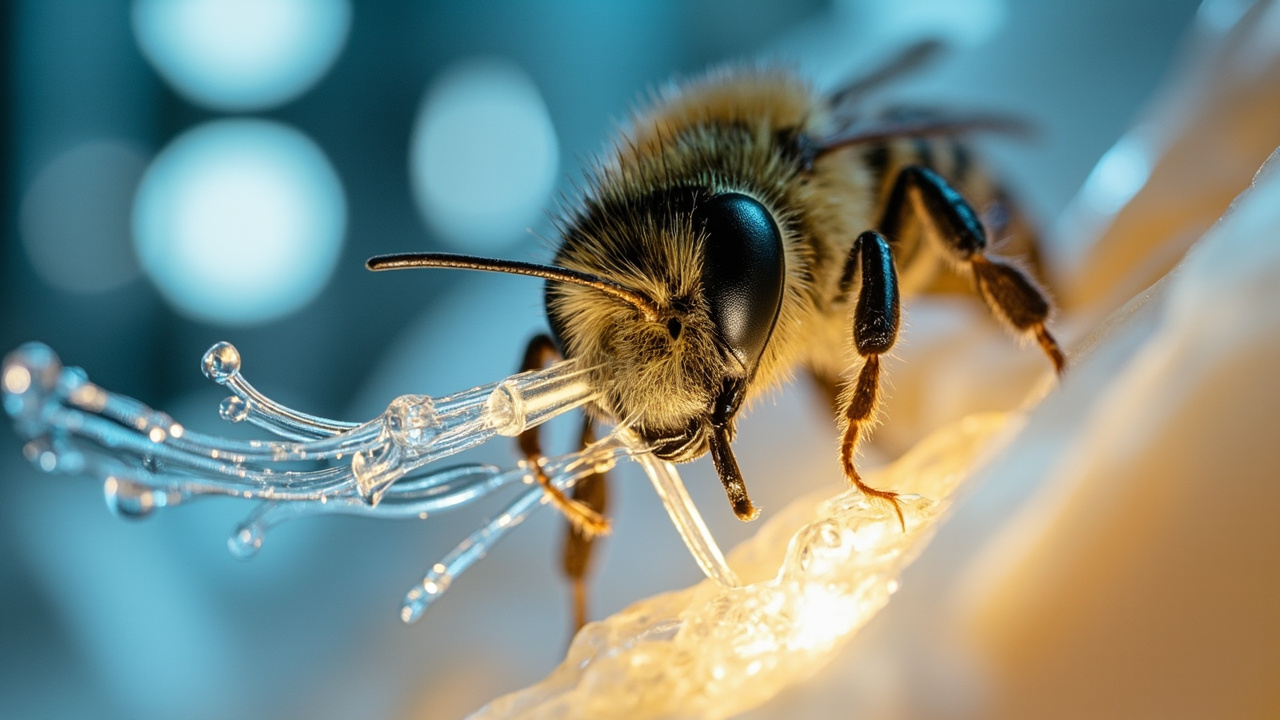
TL;DR: High-speed video shows a detached honeybee stinger pumps venom as an autonomous double-piston micropump with collapsible valves moving in opposite directions.
Detached stinger keeps working on its own
A honeybee worker leaves its stinger behind in skin and flies away, and the separated apparatus continues to drive inward and deliver venom without input from the insect. According to Ars Technica, scientists have now identified a double-piston pump-like mechanism that explains that continued delivery, in a paper in the Proceedings of the National Academy of Sciences. According to The Conversation, the detached stinger requires more than a minute to complete pumping after entry. According to CBC News reporting on the work, the separated stinger remains active for about two minutes.
The structure responsible is small. According to Phys.org, reporting on Macquarie University research, the stinger of the honey bee, Apis mellifera, measures 2 millimeters, or 0.08 inch. According to Ars Technica, three interlocking elements form the venom canal: a stylet that widens to form the principal pumping chamber and two sharp-tipped lancets that slide forward and back. According to Phys.org, the apparatus also includes a venom sac, pumping chamber, muscles and nerves.
The separation process has a formal name. According to Ars Technica, the continued penetration and pumping after the worker departs is termed autotomy. According to The Conversation, loss of the stinger can injure internal organs and can kill the bee, so deployment defends the hive even when the worker is crushed or brushed away. According to Phys.org, after a worker lands and thrusts the stinger into a target, it departs and leaves the stinger to penetrate tissue and inject venom under its own power.
Why valves puzzled researchers since 1910
The new work answers a long-standing anatomical puzzle. According to Phys.org, researchers have known since as early as 1910 that the venom sac empties into a chamber containing small pumping elements called valves. According to The Conversation, that chamber receives venom from the sac, and the function of the valves was illustrated in 1910 without a clear account of operation. According to Ars Technica, different animals deliver venom by piercing skin and moving fluid from a gland or reservoir, with spiders using muscles around venom glands to expel fluid through hollow fangs.
Stinging insects use a different arrangement. According to Ars Technica, bees, wasps and ants deliver venom through stingers, either by contraction of muscles around a venom reservoir or through stiff lancets operating together to move venom. According to The Conversation, most venomous animals hold venom in a sac resembling an unpleasant water balloon, with circular muscles squeezing to release fluid, while honeybees direct venom from the sac into a pumping chamber with valves. According to The Conversation, most natural pumps are either reservoirs constricted by muscles, exemplified by snake venom glands, or chambers deformed by muscular contraction, exemplified by lungs.
Honeybees add autonomy after separation. According to Phys.org, two long pointed lancets slide backward and forward on rails called the olistheter in a pattern compared to a reciprocating saw. According to Ars Technica, those lancets both pierce tissue and pump venom into the target. According to Phys.org, each long lancet carries an attached valve positioned inside the pumping chamber.
The research team set out to record motion directly. According to Ars Technica, the authors sought to capture venom-pumping kinematics in order to identify the biomechanics. According to The Conversation, the team filmed pumping elements inside the stinger in action for the first time. According to Phys.org, the study was published in PNAS and identified the working parts packed into the tiny stinger.
Filming translucent pumps in artificial skin
The team worked with live worker bees and separated stingers immediately before observation. According to Ars Technica, researchers collected live worker bees and removed stingers with forceps just prior to filming. According to CBC News reporting on the study, experiments used live honey bees, removed the stinger and ended the lives of the insects immediately afterward. According to The Conversation, detachment permits unobstructed observation because the stinger separates from the body.
The target was a transparent substitute for skin. According to The Conversation, researchers detached stingers and filmed them pumping venom into a clear gel that mimics human skin. According to Phys.org, researchers had bees sting a clear gel that mimics human skin and recorded autonomous pumping for the first time. According to Ars Technica, stingers were partially inserted into blocks of artificial gel before recording.
Imaging relied on magnification and speed. According to Ars Technica, the team used stereomicroscopy and high-speed color videography, followed by frame-by-frame analysis to track movement visible because structures are semi-translucent. According to Phys.org, transmitted-light illumination permitted viewing of valve pumping inside the bulb chamber. According to The Conversation, the approach combined observation of movement with later structural imaging because the stinger is small, difficult to see and geometrically complex.
Video speeds reached hundreds of frames per second. According to CBC News reporting on the study, cameras capable of capturing hundreds of frames per second were needed because stinging occurs rapidly. According to Phys.org, recordings included high-speed videography at 300 frames per second in lateral view and at 100 frames per second in lateral and dorsal views. According to The Conversation, study of the mechanism required hundreds of hours of filming.
Translucence aided visualization. According to CBC News reporting on the study, translucence of the venom sac and stinger allowed strong lighting to outline internal structures. According to Phys.org, transmitted illumination made lancet valves visible pumping within the bulb chamber. According to The Conversation, lead author Fiorella Ramirez-Esquivel reported being stung once during extensive handling of live stingers.
The work involved two universities. According to Phys.org, researchers were from Macquarie University and the University of New South Wales. According to Phys.org, lead author Fiorella Ramirez-Esquivel is with Macquarie University. According to The Conversation, author Fiorella Ramirez Esquivel described the stinger as an effectively fully autonomous micro-pump.
Two pistons moving in opposite directions
The central finding concerns paired valves operating out of phase. According to The Conversation, the pumping chamber can be imagined as a cylinder with an inlet at the top supplying fresh venom and an outlet at the bottom delivering venom into skin. According to The Conversation, two pistons sit inside the thicker portion of the stinger. According to Phys.org, each lancet valve sits inside the pumping chamber and changes shape dynamically to form a seal during the downstroke and collapse during the upstroke.
On the power stroke, the valve expands. According to Ars Technica, valves attached to each lancet change shape while sliding back and forth, inflating like a parachute on the downstroke and creating a seal through piston-like action that applies downward pressure to expel venom. According to Phys.org, valves inflate like a parachute on the downstroke, functioning as pistons to apply downward pumping pressure. According to The Conversation, the valve opens like a parachute on the downstroke, spans the cylinder diameter and creates a seal.
As the valve travels downward, fluid is expelled. According to The Conversation, downward travel pushes venom out through the outlet. According to Ars Technica, the piston-like action pushes venom outward from the chamber. According to Phys.org, downward pumping pressure acts on venom in the chamber.
At the bottom, the valve changes configuration for return. According to The Conversation, the valve reverses direction at the bottom and collapses like an umbrella to move back to the top. According to Ars Technica, valves deflate on the upstroke. According to Phys.org, valves deflate on the upstroke after inflating on the downstroke.
The return stroke limits reverse flow. According to Phys.org, valve shape change generates pressure for pumping while minimizing backflow during refilling. According to Ars Technica, the dual motion also minimizes backflow. According to The Conversation, the chamber must both permit the valves to pass each other and allow refilling.
The two valves do not move together. According to The Conversation, the two valves inside the cylinder move in opposite directions. According to Ars Technica, valves change shape again when they meet in the middle in order to push past each other. According to Phys.org, as valves meet in the middle of the stroke they change shape again to push past each other.
That crossing maneuver preserves sealing. According to Phys.org, maintaining a seal is vital to transmit pressure effectively. According to The Conversation, the valves must move past one another while still making a seal and pumping venom. According to Ars Technica, results were consistent with preliminary flow-visualization experiments.
The outcome is uninterrupted output. According to The Conversation, valves acting as collapsible pistons and pumping in opposite directions deliver continuous venom flow. According to Phys.org, valves act as collapsible pistons and, by pumping in opposite directions, deliver continuous flow. According to Ars Technica, the team observed that lancet-attached valves both reside in the venom pumping chamber and deform during sliding motion.
The stinger also advances while pumping. According to Phys.org, lancets are responsible for working the stinger deeper into skin and pumping venom. According to Phys.org, high-speed video showed the stinger working deeper into the substitute through reciprocating lancet action. According to Ars Technica, the stinger continues to penetrate tissue and pump venom on its own after separation.
Scaled-up printed model confirmed the cycle
Video alone did not resolve every structural detail, so the team added three-dimensional imaging. According to The Conversation, researchers made three-dimensional scans to model structure and compared the model with images capturing material properties and detail. According to Ars Technica, the team obtained micro-CT scans and used that data to create a 3D-printed scaled prototype to mimic observed pumping. According to Phys.org, researchers used microCT scans to 3D-print a scaled-up working model of the bulb chamber and lancets.
The printed system functioned as a physical test. According to The Conversation, the team produced a simplified, enlarged version of the stinger from the scans. According to The Conversation, the pumping chamber and valves were printed with rigid and flexible materials after testing many plastics. According to Phys.org, the scaled-up model was described as a small robot that confirmed key features of the pumping cycle.
Filming of the model matched biology. According to Ars Technica, the artificial pumping motion was filmed and analyzed frame by frame, showing the same pumping kinematics as biological stingers. According to Phys.org, exploration of mechanics and flow with the scaled model confirmed key features. According to The Conversation, testing multiple plastics led to the most suitable printed version for confirming pump operation.
Material behavior mattered. According to Ars Technica, future work may examine valve material properties closely because the artificial polymer valve indicates extremely high elasticity is central to replicating deformation, along with low friction between valves. According to The Conversation, comparison of scans with images capturing material properties helped clarify the complicated shape. According to Phys.org, the double-piston arrangement adds complexity but enables continuous delivery in a compact autonomous unit.
The authors proposed an engine analogy. According to The Conversation, honeybee stingers operate more like pistons in a car engine, except with two highly deformable pistons per cylinder. According to Phys.org, the 2-millimeter stinger functions as a sophisticated double-piston micropump. According to Ars Technica, the mechanism is described as a unique double-piston pump-like system.
What engineers could borrow next
Prior work had already drawn on stinger architecture. According to Ars Technica, earlier research used bee-stinger structure as inspiration for microneedles, tissue-transport devices and drilling devices. According to Phys.org, the authors conclude that uncovered design principles could inspire engineered micropumps. According to The Conversation, the unusual pump design could inform human-made pumps for microfluidics, drug delivery or continuous-flow pumping.
Medical and fluid-handling uses are the focus. According to Phys.org, potential applications include minimally invasive medical and microfluidic technologies. According to Ars Technica, the authors foresee similar medical and microfluidic applications such as artificial pumps. According to The Conversation, microfluidics concerns control of tiny liquid volumes.
Several questions remain open. According to Ars Technica, it would be useful to investigate whether capillary action plays a role given the small dimensions of venom-pumping elements. According to Ars Technica, capillary action could help draw venom into the venom canal, or venom may instead need to overcome capillary action drawing fluid upward from tissue. According to Ars Technica, closer examination of valve material properties is a possible direction for future research.
Publication details anchor the finding. According to Phys.org, the paper is titled The honey bee stinger: An unusual pump with collapsible double pistons and appeared in Proceedings of the National Academy of Sciences in 2026 with DOI 10.1073/pnas.2603916123. According to Ars Technica, the PNAS paper was covered on Oct. 13, 2026 by Jennifer Ouellette. According to The Conversation, the explanatory account by Fiorella Ramirez Esquivel was published Oct. 12, 2026.
Sources referenced
- High-speed video reveals how honey bee stingers pump venom - Ars Technica (https://arstechnica.com/science/2026/10/honey-bee-stingers-are-double-piston-venom-pumps/)
- How does a honeybee stinger actually pump venom? First-ever video shows it in action - The Conversation (https://theconversation.com/how-does-a-honeybee-stinger-actually-pump-venom-first-ever-video-shows-it-in-action-292789)