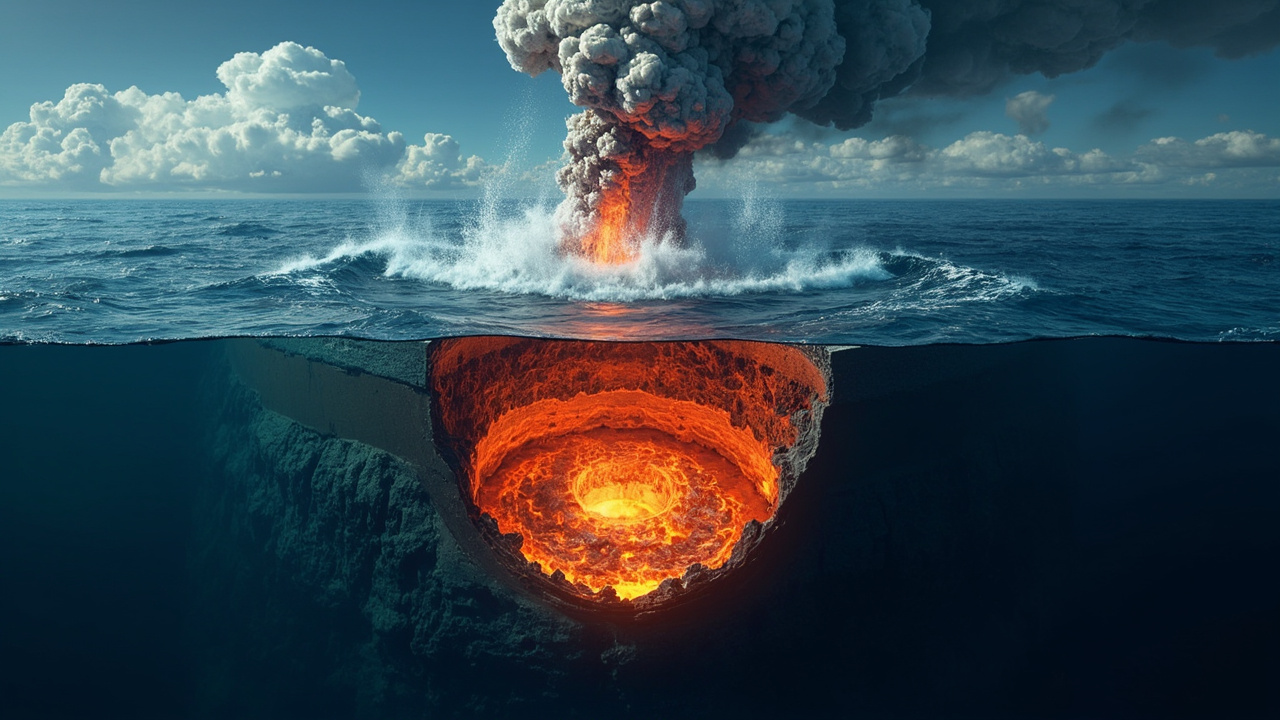
TL;DR: A roughly 4-kilometer-wide caldera at Hunga volcano in Tonga sank by about a kilometer during its January 15, 2022 eruption, and that rapid piston-style drop may have amplified a 40-meter tsunami.
Small Volcano, Giant Wave: Hunga's Seafloor Drop Rewrites Tsunami Risk
A small undersea caldera produced the highest tsunami ever recorded from an underwater volcanic eruption, and new seafloor maps show why speed of collapse mattered more than size.
According to Ars Technica, an international team compared seafloor topography before and after the 2022 Hunga eruption in Tonga and found that a roughly 4-kilometer-wide caldera sank by about a kilometer during the eruption. According to Nature Geoscience, seafloor mapping before and after the catastrophic 2022 Hunga eruption showed that the centre of the volcano collapsed by over 1 km, displacing 8.9 ± 0.1 km3 of material.
The researchers argue that the rapid collapse of the entire caldera may have enhanced the massive tsunami. According to Pacific Media Network, scientists say the collapse explains why the 2022 Hunga Tonga-Hunga Ha`apai eruption produced powerful tsunamis across Tonga and the region.
Why Krakatau still frames the question
Krakatau, a volcanic island in Indonesia, killed more than 30,000 people when it erupted in 1883. According to Ars Technica, many of the victims died from a tsunami caused by the volcanic eruption instead of from volcanic debris.
Volcanoes at sea can pose hazards quite different from those on land, as their impact can vary depending on how the volcanic activity interacts with seawater. In the deep ocean, high water pressure can suppress explosive volcanic activity, making eruptions less destructive.
But closer to the surface, the lower water pressure and the high temperatures of volcanic material can cause violent explosions. Yet scientists still do not fully understand the conditions under which volcanic activity can cause a tsunami.
To better understand these risks, an international team of researchers examined the 2022 Hunga eruption in Tonga, focusing on the rapid caldera collapse that may have amplified its powerful tsunami. Calderas form when the ground above a magma reservoir collapses as the magma drains away.
The paper warns: “The dynamics of submarine caldera-forming eruptions and, thus, the hazards they pose are not well understood, owing to the relative inaccessibility of the resulting calderas and eruption products.” That warning was quoted by Ars Technica in its September 23, 2026 report.
What happened on January 15, 2022
The Hunga volcano's eruption on January 15, 2022, ranks among the most powerful volcanic events this century. The eruption column soared more than 55 km, pushing vaporized seawater up into the stratosphere, and the pressure wave from the explosion was detected across the globe.
According to Pacific Media Network, Hunga Tonga-Hunga Ha`apai erupted violently on 15 January 2022, triggering tsunamis across Tonga and the Pacific. The accompanying tsunami is estimated to have reached heights of 40 meters within about 100 km from the source.
It is the highest tsunami ever recorded from an underwater volcanic eruption, according to Ars Technica. It also helps explain the destructive waves that reached Tonga and other Pacific coastlines, according to Pacific Media Network.
The 15 January 2022 eruption produced tsunamis, a huge atmospheric pressure wave, and a volcanic plume that rose more than 55km into the atmosphere, according to Pacific Media Network. It also damaged more than 190 kilometres of undersea telecommunications cables.
According to Nature Geoscience, geophysical surveys show that the caldera collapse occurred during the climactic eruption, triggering extreme tsunami hazards, a stratospheric eruption plume and the breakage of underwater cables.
How small Hunga is — and how deep it fell
For all its impact, Hunga's caldera is quite small. The caldera left after the eruption is about 4 kilometers in diameter, making it one of the smallest of the 177 known calderas in a global database, according to Ars Technica.
What sets Hunga apart is that its caldera is unusually deep relative to its size. Relative to its diameter, the subsidence depth was comparable to that of famous calderas like Newberry in the United States.
According to Pacific Media Network, scientists say a huge section of the seafloor collapsed almost at the same time as the eruption, sending the underwater caldera from about 150 metres deep to around 850 metres.
The study found that the caldera sank by nearly one kilometer. Before the eruption, its floor lay 150–200 meters below sea level. Afterward, the caldera reached depths of up to 850 meters.
Up to 150 meters of eruption-derived sediment covered the caldera floor, meaning the collapsed surface itself lies about 1,000 meters below sea level. The collapse of the caldera floor alone accounts for about 6.85 cubic km of volume.
About 8.9 cubic kilometres of material was displaced. Of that, scientists estimate 6.85 cubic kilometres came from the collapse of the caldera itself, according to Pacific Media Network. According to Nature Geoscience, the total displacement was 8.9 ± 0.1 km3.
The study found the caldera, which is about five kilometres wide, collapsed in a rapid, piston-like movement as the volcano erupted, according to Pacific Media Network. Comparisons of seafloor topography before and after the eruption showed that a roughly 4-kilometer-wide caldera sank by about a kilometer during the eruption, according to Ars Technica.
Why speed may matter more than size
The researchers suspect that the speed of the caldera collapse may have been one of the factors behind the massive tsunami. In general, when a submarine caldera collapses, the sinking seafloor pulls the seawater above it along with it.
If the seafloor hundreds of meters below the surface drops abruptly, as it did at Hunga, a large volume of water can be displaced in a short time, potentially creating a tsunami, according to Ars Technica.
When such a large section of the seafloor suddenly drops, it pushes and pulls a huge amount of seawater with it. Scientists say this rapid movement would have added to the tsunami generated by the eruption, according to Pacific Media Network.
The researchers argue that the rapid collapse of the entire caldera may have enhanced the massive tsunami. Even a relatively small caldera like Hunga may be capable of producing a dangerous tsunami, depending on the speed and nature of its collapse.
This suggests that other underwater volcanoes may also have the potential to generate dangerous tsunamis. The speed of the collapse is what matters most for understanding the tsunami, according to Pacific Media Network.
A roof too thin to hold
The geometry of Hunga's magma reservoir is considered one of the factors behind the rapid collapse. The reservoir's roof was thin and broad, so it could barely support itself once the magma drained away.
The reservoir lay about 2 kilometers beneath the volcano, shallow compared to its considerable width of 4 to 5 kilometers. The team calculated that the roof could cave in if reservoir pressure fell by only about 30 megapascals, roughly 300 times atmospheric pressure.
That means losing just a quarter of the magma present pre-eruption would be enough to bring the roof down, according to Ars Technica.
The Korea Polar Research Institute (KOPRI) led the study with international researchers, including scientists from New Zealand, according to Pacific Media Network. They used detailed maps of the seafloor taken before and after the eruption to measure the changes.
In the paper, the team reconstructed how the collapse of the Hunga volcano unfolded. They compared a pre-eruption seafloor map made in 2015–2016 with post-eruption maps from five surveys conducted between April and October 2022, according to Ars Technica.
The new findings, published in Nature Geoscience, give scientists a much clearer picture of how the eruption reshaped the seafloor and helped drive the powerful tsunamis that struck Tonga and other parts of the Pacific, according to Pacific Media Network.
Collapse during eruption, not after
The Hunga caldera is thought to have collapsed even as the volcano was erupting. The sedimentary structures preserved beneath the caldera floor support this idea.
A ship-based seismic survey conducted about three months after the eruption found that landslide deposits from the collapsing caldera walls were present below, within, and above the pyroclastic layers left by the eruption.
The alternation of the two types of sediments suggests that debris from the broken walls was sliding down while pyroclastic material was still accumulating. If the caldera had collapsed after the eruption, the landslide deposits should lie on top of the pyroclastic layers, according to Ars Technica.
The study also found evidence that landslides were happening at the same time as the caldera was collapsing, according to Pacific Media Network. Researchers say this shows the eruption was not a single event but a series of violent changes happening together beneath the ocean.
According to Nature Geoscience, geophysical surveys show that the caldera collapse occurred during the climactic eruption. That timing is central to the tsunami argument, because water displacement during the eruption would combine with other eruption-driven waves.
A piston, not a rubble pile
One notable aspect of the Hunga collapse is the style in which it fell. Rather than breaking into pieces, the caldera floor maintained its shape as a whole, largely without bending, according to Ars Technica.
The researchers identified the event as a “piston-style collapse,” so named because the floor drops the way a piston slides down a cylinder. The maps support this interpretation.
The topography of Hunga shows distinct features along the eastern and southern walls of the caldera, according to Ars Technica. The study found the caldera collapsed in a rapid, piston-like movement as the volcano erupted, according to Pacific Media Network.
For Tonga, the findings offer a better picture of what happened during one of the most powerful volcanic eruptions of the modern era, according to Pacific Media Network.
How the maps were made
The new study was made possible by repeated high-resolution surveys of the volcano. Just months after the eruption, researchers were able to return to the site and map the new seafloor, according to Pacific Media Network.
Scientists aboard KOPRI's research vessel Araon surveyed the seafloor around Hunga Tonga-Hunga Ha`apai after the 2022 eruption, according to Pacific Media Network.
They compared a pre-eruption seafloor map made in 2015–2016 with post-eruption maps from five surveys conducted between April and October 2022, according to Ars Technica. A ship-based seismic survey conducted about three months after the eruption provided the sedimentary detail.
During a volcanology mission to three Tongan volcanoes in November 2025, Tonga Geological Services was part of a team that visited Hunga Tonga-Hunga Ha`apai, Tofua and Home Reef, according to Pacific Media Network.
Tonga's Ministry of Lands, Survey, Planning and Natural Resources said it would continue daily monitoring of Home Reef using satellite observations of heat flow and sulphur dioxide, as well as visual and radar imagery, according to Pacific Media Network.
What this means for other undersea volcanoes
Even a relatively small caldera like Hunga may be capable of producing a dangerous tsunami, depending on the speed and nature of its collapse, according to Ars Technica. This suggests that other underwater volcanoes may also have the potential to generate dangerous tsunamis.
The scale of what happened beneath Tonga during the 2022 Hunga Tonga-Hunga Ha`apai eruption is becoming clearer, according to Pacific Media Network. Scientists say a huge section of the seafloor collapsed almost at the same time as the eruption.
Still, the paper warns that the dynamics of submarine caldera-forming eruptions and the hazards they pose are not well understood, owing to the relative inaccessibility of the resulting calderas and eruption products, according to Ars Technica.
The findings were published in Nature Geoscience as a summary of work by Ribó, M. et al. titled Rapid submarine caldera collapse during the 2022 climactic eruption of Hunga volcano (Tonga), according to Nature Geoscience. The Research Briefing was published on 23 September 2026.
Sources referenced
- Small undersea volcanoes may unleash outsized tsunamis - Ars Technica (https://arstechnica.com/science/2026/09/small-undersea-volcanoes-may-unleash-outsized-tsunamis/)
- Sudden collapse of submarine volcano drives extreme hazards | Nature Geoscience (https://www.nature.com/articles/s41561-026-02098-8)