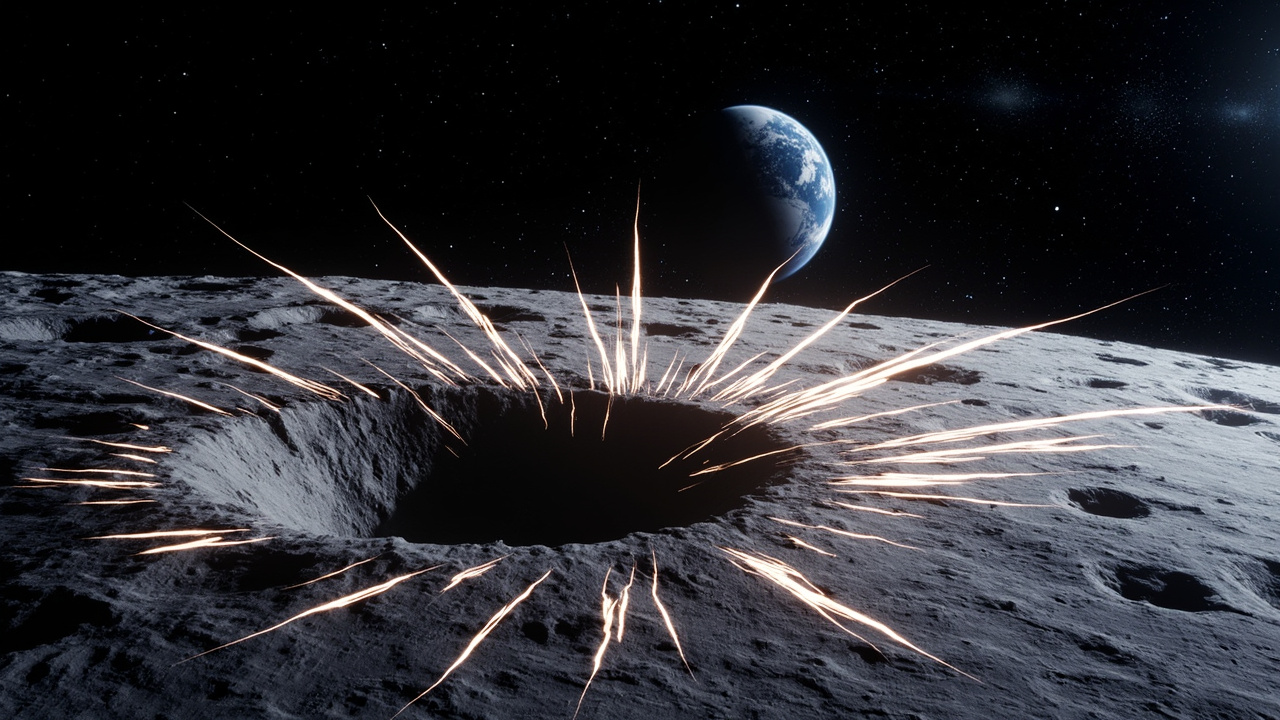
The Moon Got Hit Hard — And Scientists Just Found the Crater
TL;DR: NASA's Lunar Reconnaissance Orbiter discovered McGetchin crater, a 222-meter-wide, 43-meter-deep lunar crater formed between April 11 and May 22, 2024, the largest newly formed crater ever found in the solar system and a once-in-132-year impact event.
A space rock the size of a three- to six-story building slammed into the Moon's eastern edge between April 11 and May 22, 2024, carving a steep-sided hole 728 feet across and 141 feet deep, according to NASA Science. The crater, officially named McGetchin crater, was not spotted in real time and was only recognized more than a year later during a routine check of orbital images, as reported by NASA Science. Scientists described the find in a pair of papers published Sept. 15-16, 2026, in the journal Science Advances, calling it the largest contemporary impact crater found anywhere in the solar system and, under current models, a once-in-132-year event.
A two-football-field scar on the Moon's eastern edge
McGetchin crater measures 222 meters in diameter, spanning the length of two football fields, according to NASA Science. The crater is 728 feet wide and up to 141 feet deep, according to The Associated Press. At 141 feet deep, the bowl could fit three vertically stacked yellow school buses, according to NASA Science.
The crater formed on the Moon's eastern edge, on the near side visible from Earth, according to NASA Science and The Associated Press. Its center lies at 1.3536 degrees north latitude and 67.1765 degrees east longitude, at an elevation of minus 846 meters before the impact, according to the Science Advances paper titled "A new 222-m diameter lunar crater."
The site sits on or near a highland-mare contact just inside the outer rim of the Crisium basin, according to that Science Advances paper. The 1,080-kilometer ring of Crisium has been identified in prior basin mapping, and the new crater lies 330 kilometers from the edge of Mare Crisium, according to the same paper. Mare materials there had embayed the southeastern flank of Dubyago N crater, a 7,200-meter-diameter crater, according to the same paper.
The surface of Mare Spumans, 20 kilometers west of the new crater, sits about 1,000 meters lower than the new crater site, according to the Science Advances paper. A local high point interpreted as an ancient eruptive center occurs 23 kilometers east-southeast of the new crater, according to the same paper. From that eruptive center, basalt flowed to the northwest, met a topographic high, and was diverted to the northeast and then again to the northwest, according to the same paper.
A once-in-a-lifetime impact
Crater production models indicate that an impact of this magnitude is expected to occur only once every 132 years on the Moon, according to the Science Advances paper. The authors wrote that the event constitutes a statistically rare, effectively once-in-a-lifetime observation, according to The Associated Press account of the studies.
NASA Science described the collision as a once-in-a-century event or even longer, noting that scientists estimate an impact of this magnitude happens on the Moon about once in a century or even longer. The Lunar and Planetary Institute summarized the frequency as about once every 130 years for a 222-meter crater.
Before McGetchin, the largest contemporary impact crater discovered on the Moon had a 70-meter diameter, according to the Science Advances paper. McGetchin is three times bigger than that previous record-holder found by the Lunar Reconnaissance Orbiter a decade ago, according to The Associated Press. The magnitude of the McGetchin formation event was calculated at 6.5 times 10 to the 10th kilojoules, more than an order of magnitude greater energy than the 70-meter crater event at 2.4 times 10 to the 9th kilojoules, according to the Science Advances paper.
That energy estimate assumed an impactor density of 3 grams per cubic centimeter and an impact velocity of 15 kilometers per second, according to the same paper. The same calculation framework places a 10-meter-diameter event more than four orders of magnitude below McGetchin in energy, according to the same paper. The incoming object was an incoming fragment of an asteroid or comet, according to The Associated Press.
How a bright spot on a map gave it away
The discovery began as a routine data-quality check, according to NASA Science. Robert Wagner, a scientist with NASA's Lunar Reconnaissance Orbiter and an image-processing specialist from Intuitive Machines who works with Lunar Reconnaissance Orbiter Camera system data, scanned a giant Moon map on his computer screen and noticed an unusually large bright spot circled by a dark halo, according to NASA Science.
Wagner said he stopped other work to investigate the spot, telling NASA Science, "I just stopped, dropped everything, and started looking into what that spot was." By comparing before and after images of the Moon, Wagner realized he had found the largest newly formed crater ever identified in the solar system, according to NASA Science.
The Lunar Reconnaissance Orbiter Camera Wide Angle Camera images the whole Moon each month at 100-meter scale and has done so since 2010, according to the Science Advances paper. Comparing images from two months under similar lighting conditions enables automated detection of surface changes, according to the same paper. In fall 2025, a routine temporal comparison of Wide Angle Camera image sets revealed the new 222-meter-diameter crater that formed in spring 2024, according to the same paper.
NASA's Lunar Reconnaissance Orbiter spotted the crater on the Moon's near side in May 2024 soon after it formed, but the Wide-Angle images were not identified in the crush of data until August 2025, according to The Associated Press. The spacecraft gathered more detailed pictures last fall, followed by confirmation of the discovery early this year, according to The Associated Press.
From wide view to meter-scale close-up
The white spot first seen in wide-angle views was not the crater itself but material flung out of the crater, according to NASA Science. The panel comparison published by NASA paired images captured by the Wide-Angle Camera in summer 2025 with images taken in spring 2011 over an area 38 miles wide, according to NASA Science.
Later, a series of Lunar Reconnaissance Orbiter Camera Narrow Angle Camera images provided high-resolution meter-scale photometric and topographic information, according to the Science Advances paper. Those images show that the crater exposed complex geology and document widespread surface changes extending more than 1,000 crater radii, according to the same paper.
Crater diameter ranges from 213 meters in an east-southeast direction to 231 meters in a north-northeast direction, for a 222-meter average diameter, according to the Science Advances paper. The rim was defined as the point where directional slope is closest to zero moving away from the geometric center, switching from positive inside the crater to negative on the ejecta, according to the same paper.
Basic crater parameters were measured from a Narrow Angle Camera stereo-based Digital Terrain Model at 3 meters per pixel with better than 1.5-meter vertical precision, plus corresponding 1-meter-per-pixel orthomosaics and a pre-impact Kaguya Terrain Camera terrain model, according to the Science Advances paper. The rim elevation varies, with a minimum of minus 842 meters and a maximum of minus 832 meters, or minus 835 meters after excluding a large boulder that straddles the southern rim, according to the same paper.
What the orbiter has seen over 17 years
For more than 17 years, the Lunar Reconnaissance Orbiter has been circling the Moon and using its seven instruments to map topography, surface composition, temperature and the radiation environment, according to NASA Science. The spacecraft team has identified at least 1,000 new impact craters throughout the mission and flagged 100,000 more surface changes from objects smashing into the Moon or debris flung out afterward, according to NASA Science.
With no atmosphere to slow them or burn them up, space rocks and other objects easily reach the lunar surface, according to NASA Science. Most are much smaller than the object that carved McGetchin crater, according to NASA Science. The smallest craters scientists can distinguish in orbiter images are about 30 feet wide, the length of a three-story building laid on its side, made by rocks about 43 inches wide, the size of a monster-truck tire, according to NASA Science.
Scientists estimate that impacts at that small scale produce about 140 new craters across the Moon each year, according to NASA Science. But most new ones are made by microscopic projectiles that leave holes too small to identify in orbital images, according to NASA Science.
The orbiter was launched in 2009, and its numerous crater discoveries since then show that the Moon's top inch, or 2 centimeters, of soil is being overturned by ejected material every 80,000 years, faster than previously thought, according to The Associated Press account of lead author Mark Robinson's findings. Contrary to the popular belief that Apollo moonwalkers' dusty footprints will last forever, they will be long gone in that time frame, Robinson said in an email quoted by The Associated Press.
A 4-mile-wide cold spot around the crater
After the crater was discovered, scientists working with the orbiter's thermal instrument, Diviner, made follow-up observations of the site, according to NASA Science. They found a 4-mile-wide area around the crater that is about 16 degrees Fahrenheit cooler at night than its surroundings, according to NASA Science.
A separate study identified a 7-kilometer-wide cold spot around the new crater, consistent with a loosening of the Moon's top soil, according to The Associated Press. Reporting in a second paper in Science Advances, researchers said the cooling happens because the impact fluffs up the regolith around the crater, making it less dense and therefore less able to retain heat, according to NASA Science.
The post-impact temperature image was constructed using Diviner data taken between Nov. 15, 2025, and Feb. 18, 2026, after scientists discovered the crater in visible-light Wide-Angle Camera images, according to NASA Science. Pre-impact temperatures came from the Diviner Global High-Resolution Mosaics, according to NASA Science. The Diviner team reported the cold-spot finding in a paper published Sept. 16, 2026, in Science Advances, according to NASA Science.
The large extent of the cold spot is striking because it shows that impacts can modify the Moon's surface far beyond the crater itself, according to NASA Science. These physical changes could affect how rover wheels interact with the surface, for instance, according to NASA Science. Co-author David Paige of the University of California, Los Angeles, likened the process to gardening, saying in a statement quoted by The Associated Press, "We're now thinking of impacts as a way to garden the regolith."
Ejecta, boulders and churned ground for 66 miles
The latest impact churned the lunar surface for more than 66 miles, or 100 kilometers, according to The Associated Press. Dust and rocky soil were hurled away at a higher angle than expected, according to Mark Robinson, chief scientist for the Lunar Reconnaissance Orbiter's cameras who works at Intuitive Machines and was lead author for one of the studies, as quoted by The Associated Press.
The crater is surrounded by a bright blanket of ejecta — rock and dust that splashed out in all directions when the impact occurred — that extends hundreds of meters from the rim, according to the Lunar and Planetary Institute. The highest-reflectance ejecta lies primarily within two crater radii of the rim in the early mapping work, with the most reflective materials occurring beside a narrow tongue of intermediate-reflectance material emanating from the rim region, according to the conference mapping summarized ahead of the Science Advances paper.
High-resolution multitemporal datasets acquired before and after the impact provide the opportunity to quantify the spatial extent, magnitude and temporal evolution of surface modification associated with a recently formed large fresh lunar crater, according to the Science Advances paper. The authors said the event enables new constraints on ejecta emplacement, boulder distribution, rim uplift and distal surface alteration, according to the same paper.
The next step is to calculate the risk of ejected crater material striking NASA's planned moon base, Robinson said, as quoted by The Associated Press. That information will help engineers harden structures so occupants will not have to worry about damage, or will have to worry less, according to Robinson's statement as quoted by The Associated Press. The discovery highlights the value of orbiter data in studying a dynamic landscape as the agency advances a sustained human presence and expanded scientific and commercial activity on the Moon, according to NASA Science.
Named for Thomas McGetchin
The crater is officially named McGetchin crater after Thomas McGetchin by the International Astronomical Union, according to the Lunar and Planetary Institute. McGetchin served as director of the Lunar and Planetary Institute, then known as the Lunar Science Institute, beginning in 1977, according to the same institute account. That year also marked the inaugural summer of the institute's Summer Intern Program in Planetary Science, according to the same account.
McGetchin was a renowned volcanologist and lunar scientist who made lasting contributions to planetary science, according to the Lunar and Planetary Institute. The model of impact-crater ejecta developed by McGetchin and colleagues in 1973 remains an important framework for interpreting the formation and distribution of ejecta around impact craters and basins, according to the same institute account. McGetchin was described as a pioneering lunar scientist and as the late former director of Houston's Lunar and Planetary Institute, according to NASA Science and The Associated Press.
The Science Advances papers were led by Mark S. Robinson with co-authors Aaron K. Boyd, Prasun Mahanti, Madeleine R. Manheim, Emerson J. Speyerer, Julie D. Stopar and Robert V. Wagner, according to the Lunar and Planetary Institute summary of the author list. Robinson is principal investigator for the camera team and is with Intuitive Machines, while Stopar is with the Universities Space Research Association's Lunar and Planetary Institute, according to the same summary.
Sources referenced
- NASA’s Moon Orbiter Spots New, ‘Once-in-Century’ Moon Crater - NASA Science (https://science.nasa.gov/solar-system/moon/nasas-moon-orbiter-spots-new-once-in-century-moon-crater/)
- Huge New Crater On The Moon | Associated Press via Air1 (https://www.air1.com/faith/news/positive-news/huge-new-crater-on-the-moon-59064)