TL;DR: ESA-led LISA will fly three laser-linked spacecraft to detect gravitational waves from space, with NASA supplying key hardware while paying about a third of the cost for full access to the data.
NASA is holding onto one major science partnership with Europe even as it rewrites the rules for international cooperation, and agency scientists say the math explains why.
The project is the Laser Interferometer Space Antenna, or LISA, described by Ars Technica in "If you're looking, here's a 'good deal' for NASA and the European Space Agency" as the world's first space-based observatory for detecting and studying gravitational waves. As currently envisioned, the mission will be led by the European Space Agency, with significant contributions from the United States, with launch scheduled for around 2035.
According to that Ars Technica report, published Oct. 7, 2026, the U.S. science lead for the mission calls the arrangement unusually favorable. "We are in the era of people interested in having good deals, and LISA is a very good deal for the US," said Ira Thorpe, a gravitational wave astronomer at NASA's Goddard Space Flight Center and leader of the U.S. science team for LISA.
The value argument is straightforward: the United States pays for roughly a third of the mission and receives all of the science data. Thorpe said in a presentation to the National Academies' Committee on Astronomy and Astrophysics that the U.S. share means 100 percent access to the observations, calling that very good leverage. He estimated that building LISA alone would cost the United States roughly $3 billion, according to a summary of that presentation published by Outer Space Today.
That framing matters because NASA's broader partnership policy has tightened. NASA Administrator Jared Isaacman has said international partners must be ready to make "meaningful contributions" with greater urgency than before, meaning they should offer something NASA or U.S. companies are not already doing and deliver it when NASA needs it, according to Ars Technica.
A Moon-first NASA redefines partnerships
NASA's emphasis without a massive budget hike is building a Moon Base and competing with China over lunar real estate and resources, a shift that will inevitably leave lesser priorities behind, according to Ars Technica.
Gone is the Lunar Gateway, a space station that was to be assembled in orbit around the Moon. For the United States, Gateway was described as an unnecessary distraction and expense as NASA goes all-in on placing a surface station near the Moon's south pole.
NASA also canceled the Mars Sample Return mission after its budget ballooned beyond $10 billion. It would have cannibalized the agency's budget for robotic science missions, a funding line already in jeopardy as the Trump administration directs NASA to focus on human spaceflight and a Moon Base, according to Ars Technica.
Before their cancellation, each project involved extensive cooperation with NASA's international partners, but NASA was the leader on both. The report notes that a nation's priorities will change with elections and external pressures, like the 21st-century space race taking shape with China.
That transition is creating friction in some areas. It is most apparent between NASA and the European Space Agency, which is struggling to find a place in NASA's Moon Base program after the cancellation of Gateway. Isaacman dismissed an ESA proposal earlier this year to develop a European cargo lander to carry supplies for the Moon Base, a role NASA officials expect U.S.-built landers to fill sooner, according to Ars Technica.
In the same discussion, Isaacman cited examples of what the administration considers a good deal in international spaceflight in the Trump era: Japan's commitment to provide a pressurized rover for astronauts on the Moon and Italy's agreement to build what will likely be the first habitat for the Moon Base.
LISA is presented as another example, but in a different domain. Unlike the lunar program, where NASA is the clear lead, ESA clearly leads LISA and NASA serves as a critical major partner. Thorpe called it the largest science mission that ESA has attempted, using the phrase "Full stop," according to Outer Space Today.
What LISA will do
LISA is designed to open a part of gravitational-wave astronomy that ground facilities cannot currently reach.
Gravitational waves are a relatively new area of astronomy, using detectors spread across a wide area, like on a continent or in space, to identify ripples in the fabric of space-time generated by cataclysmic events in the distant cosmos, according to Ars Technica. Beginning with the first detection with a ground-based observatory in 2015, astronomers have used gravitational waves rippling across the Universe to reveal the collisions of black holes and neutron stars in faraway galaxies.
NASA Science, in "NASA Advances LISA Mission Contributions With New Test Telescope," published Oct. 8, 2026, describes LISA as a space observatory designed to detect ripples in space-time called gravitational waves. Led by ESA, the mission is slated for launch in the mid-2030s.
ESA's LISA Archive calls LISA the first space-based observatory dedicated to studying gravitational waves, describing those waves as ripples emitted during the most powerful events in the Universe, such as pairs of black holes coming together and merging.
The observatory is intended to study the origin of black holes and the formation of galaxies, as well as test Einstein's general theory of relativity, according to UA.News reporting on the Ars Technica account. LISA will be more sensitive than ground-based detectors to lower-frequency gravitational waves, including those that may arise during mergers of supermassive black holes.
Thorpe said LISA will reveal a sea of low-frequency gravitational waves that cannot currently be detected through facilities on Earth, according to NASA Science. The agency quoted him saying the mission will be able to detect mergers of monster black holes billions of light-years away, map compact pairs of white dwarfs, neutron stars, and stellar-mass black holes in the agency's own cosmic backyard, and perhaps provide new insights into gravity itself.
The history stretches back decades. The idea for LISA has been around for decades, but the concept was supercharged in 2015 with the first detection of gravitational waves by a ground-based observatory and the launch of LISA Pathfinder, a satellite to demonstrate that the technologies behind LISA would actually work, according to Ars Technica.
NASA Science adds that gravitational waves were predicted by Albert Einstein's 1916 general theory of relativity and first detected by ground-based observatories in 2015. The waves form whenever massive objects accelerate, such as two stars in orbit around each other. They flow across space-time, moving at the speed of light, and are unaffected by objects they encounter along the way.
In 2016, ESA's LISA Pathfinder mission showed that it was possible to reduce non-gravitational forces on the proof masses to the level needed for gravitational wave detection, according to NASA Science.
Three spacecraft, one giant triangle
The flight design uses distance itself as the instrument.
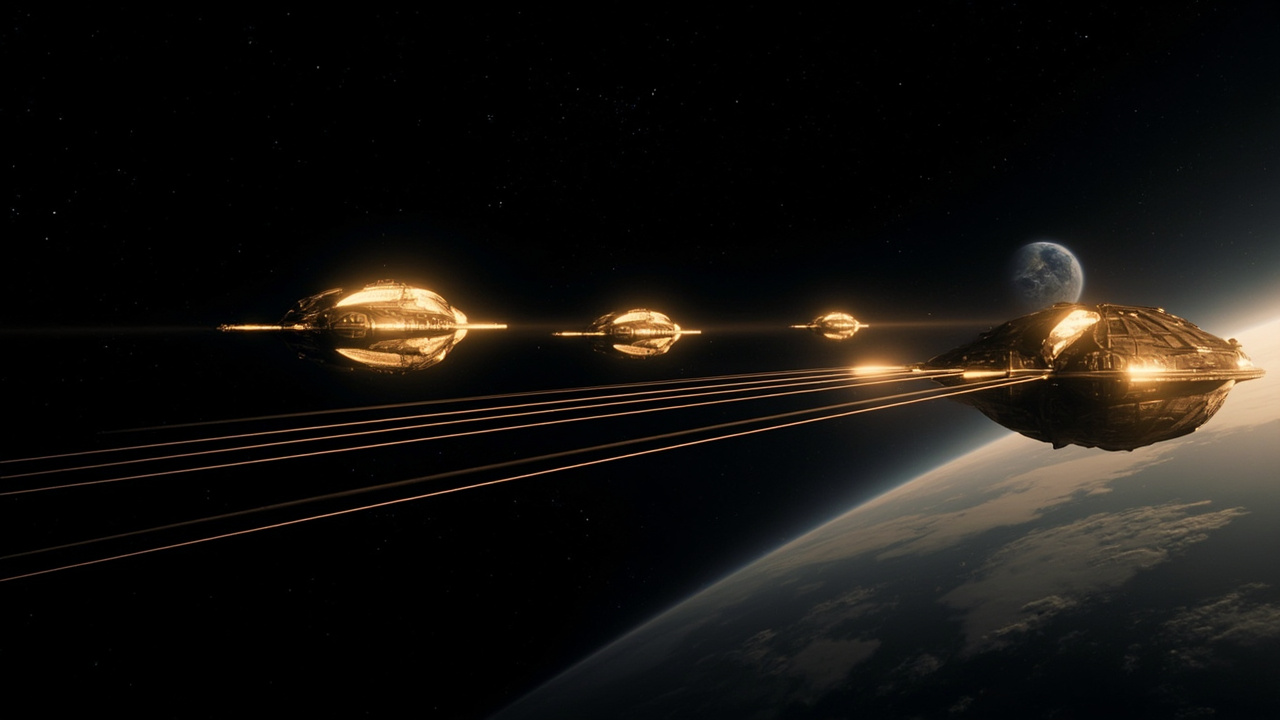
As currently envisioned, LISA will use three spacecraft flying in a triangle formation in heliocentric orbit, positioned nearly 1.6 million miles, or 2.5 million kilometers, apart to pick up the faint signals of low-frequency gravitational waves, according to Ars Technica.
NASA Science gives the same scale in different terms: the mission will deploy a trio of satellites into an Earth-following orbit, creating a vast triangular array stretching 1.6 million miles, or 2.5 million kilometers, on each side. Telescopes aboard each of the three spacecraft will simultaneously transmit and receive infrared laser beams, measuring their mutual distances to extremely high precision across that span.
ESA's LISA Archive lists three spacecraft and six laser beams among the mission basics, with a science expectation of more than 10,000 gravitational-wave events. The archive lists launch as planned for 2035, from Europe's Spaceport in French Guiana, on an Ariane 6, into a heliocentric orbit trailing or leading Earth. NASA Science more broadly describes launch as slated for the mid-2030s.
Each satellite will include two telescopes that will use infrared laser beams to simultaneously transmit and receive signals between adjacent spacecraft. Through these telescopes, the spacecraft will measure minuscule changes in their relative distances, the signals of passing gravitational waves, according to NASA Science.
The measurement challenge is extreme. Each spacecraft will carry two free-floating gold-platinum cubes inside an internal Faraday cage that protects them from all external disturbances other than gravitation, canceling out thruster firings, spacecraft vibrations, and the almost imperceptible influences from solar radiation pressure and interplanetary dust, according to Ars Technica.
Each of the three LISA spacecraft contains a free-floating gold-platinum cube called a proof mass, according to NASA Science. The spacecraft will fly around the cube and manage its environment so the cube falls through space only under the influence of gravity.
The LISA spacecraft will literally fly themselves around the free-floating cubes inside them, while inter-satellite lasers measure the exact distances between the test masses, according to Ars Technica. The laser ranging instruments must be sensitive enough to detect a change in distance smaller than the size of an atom to confirm a gravitational wave detection.
NASA Science phrases the sensitivity as even finer: the changes are tiny, smaller than the width of a helium atom, but through them LISA will reveal low-frequency waves invisible from the ground.
Who builds what
The work split is distinct, and it is central to the good-deal claim.
Under its agreement with ESA, NASA is responsible for supplying the transmitters and telescopes for the lasers, according to Ars Technica. NASA will also provide charge management devices to reduce the buildup of electric charge on the proof masses inside each spacecraft and support data analysis on the ground to find the sources of LISA's gravitational wave detections. Europe will build the spacecraft, launch them, and operate them.
NASA Science lists the same U.S. hardware responsibilities in broader terms: NASA is contributing the telescopes, other critical hardware, and engineering and scientific support. Additional NASA contributions include the laser system, devices to manage the buildup of electric charge on the proof masses, data analysis for identifying and characterizing individual gravitational wave sources, and additional scientific and engineering expertise.
The newest hardware milestone concerns the telescopes. NASA has taken the next step in developing a new all-glass telescope for LISA, according to NASA Science. L3Harris Technologies will design, assemble, and integrate the new telescope for NASA. Called the Engineering Test Unit, this contribution represents a final step toward the future production of flight hardware.
Via Satellite, in "L3Harris to Build Telescope for ESA's LISA Mission," reported Oct. 9, 2026, that L3Harris will build that all-glass telescope for the Laser Interferometer mission.
Each telescope will be entirely made of an amber-colored ceramic-glass composite called Zerodur, which is widely used in high-precision applications because it resists changes in shape across a wide range of temperatures, according to NASA Science. In 2024, L3Harris delivered a prototype telescope to NASA that served as an engineering development unit for this next step.
A technician in a clean room at NASA Goddard inspected the prototype LISA telescope delivered by L3Harris in May 2024, according to NASA Science. The entire telescope is made from an amber-colored glass-ceramic that resists changes in shape over a wide temperature range, with the mirror surface coated in gold.
"We've put the prototype through rigorous testing, and we're bringing everything we've learned into this new telescope," said Ritva Keski-Kuha, lead for the LISA Telescope program at NASA Goddard. "This will be our last pre-flight unit and our first optical telescope delivery to ESA." Earlier this year, in June, the team delivered a structural model of the telescope made from metal instead of glass, according to NASA Science.
The delivery sequence therefore moves from a 2024 prototype, to a metal structural model in June, to an all-glass Engineering Test Unit, and eventually to flight hardware.
The money and the politics
Cost-sharing is where cooperation meets budget pressure.
ESA approved LISA's development in 2024 with a budget of 1.75 billion euros, or approximately $2 billion, according to UA.News. That amount does not cover contributions from the United States and individual ESA member states.
NASA's work is expected to cost around $1 billion, although the agency has not yet approved a final budget commitment, according to the same account. Thorpe estimated that building LISA alone would cost the United States roughly $3 billion.
Those figures help explain why NASA scientists argue the partnership preserves access to flagship-scale science without a flagship-scale solo bill. NASA is not working on its own gravitational-wave observatory in space and likely could not afford one alone, a point emphasized in Thorpe's assessment of the partnership, according to the available summaries of his remarks.
But the U.S. contribution has faced political uncertainty. The Trump administration had previously proposed ending NASA's participation in LISA along with dozens of other scientific programs, according to UA.News. Congress rejected the cut and restored funding for fiscal year 2026 in a law signed by President Donald Trump after congressional approval. The administration again proposed eliminating NASA's contribution in its budget request for fiscal year 2027.
Thorpe said the repeated proposals caused understandable concern in Europe, but the project team continues its work, according to Outer Space Today. For ESA, the congressional restoration for 2026 was expected to signal Washington's support for the project.
The schedule still leaves years of joint engineering ahead. Scientists are in the early stages of developing the mission, according to Ars Technica, even though key technologies have already been demonstrated in flight. The path from Engineering Test Unit to flight telescopes, laser transmitters, charge-management hardware, ground-analysis tools, European spacecraft, launch, and operations will determine whether the triangle in space performs as designed.
If it does, the payoff described by both agencies is a continuous record of low-frequency ripples from merging black holes, compact stellar remnants, and possibly unexpected sources. The United States would receive that record without building, launching, or operating the three spacecraft. Europe would lead the largest science mission it has attempted while relying on U.S. optics, lasers, charge control, and analysis support.
That mutual dependence is the reason LISA keeps appearing in discussions of future cooperation. It pairs a European-led spacecraft and operations role with U.S. components that NASA or U.S. industry can uniquely supply on the needed schedule, matching Isaacman's stated test for meaningful contributions, while giving NASA access to a new observational window it does not plan to open alone.
Sources referenced
- If you're looking, here's a "good deal" for NASA and the European Space Agency - Ars Technica (https://arstechnica.com/space/2026/10/nasa-is-keen-on-pursuing-at-least-one-joint-science-mission-with-europe/)
- NASA Advances LISA Mission Contributions With New Test Telescope - NASA Science (https://science.nasa.gov/missions/lisa/nasa-advances-lisa-mission-contributions-with-new-test-telescope/)