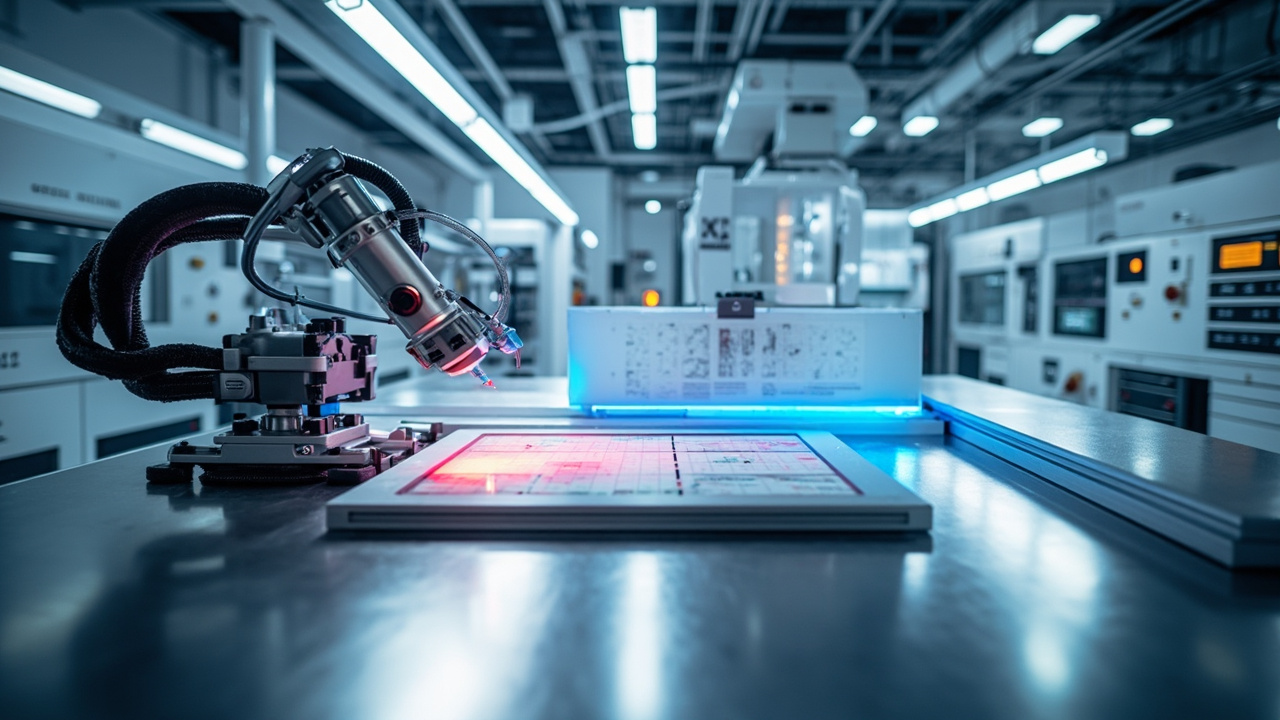
TL;DR: A Cornell–Caltech team published an autonomous synthesis extension to SARA that pairs automated X-ray phase labeling with human-guided AI reasoning, and demonstrated it on thin-film oxides including Bi–Ti–O.
Published on 10 September 2026 in PRX Intelligence as article 013019, the study reports SARA-H, or SARA with human-in-the-loop, which uses phase information from an automated probabilistic labeling algorithm to steer active-learning searches toward targeted phase regions.
What was published and when
The paper titled “Autonomous Materials Exploration Integrates Automated Phase Identification and AI Agents Enhanced by Human Guidance” appeared in PRX Intelligence, volume 1, article 013019 (2026), according to the journal record for DOI 10.1103/c362-349b.
The journal record lists receipt on 17 April 2026, acceptance on 22 July 2026, and publication on 10 September 2026.
The work is presented as an autonomous materials synthesis extension to SARA, the Scientific Autonomous Reasoning Agent, as described in the PRX Intelligence paper.
The expanded framework is called SARA-H, meaning SARA with human-in-the-loop, and the paper states that human input is incorporated to enhance the efficiency of the underlying reasoning process.
Who conducted the research
The PRX Intelligence paper lists Ming-Chiang Chang, Maximilian Amsler, Duncan R. Sutherland, Sebastian Ament, Katie R. Gann, Lan Zhou, Louisa M. Smieska, Arthur R. Woll, John M. Gregoire, Carla P. Gomes, R. Bruce van Dover and Michael O. Thompson as authors.
The author affiliations connect the Department of Materials Science and Engineering at Cornell University in Ithaca, New York, and the Department of Computer Science at Cornell University, according to the same journal record.
Additional affiliations connect the Division of Engineering and Applied Science at the California Institute of Technology in Pasadena, California, and the Liquid Sunlight Alliance at the California Institute of Technology, according to the same record.
The record also lists the Cornell High Energy Synchrotron Source at Cornell University, indicating synchrotron characterization participation in the work described in the PRX Intelligence paper.
Contact authors identified in the record are Ming-Chiang Chang, Maximilian Amsler and Michael O. Thompson, with Chang and Amsler noted as equally contributing authors.
The core problem in autonomous experimentation
The PRX Intelligence paper frames autonomous experimentation as combining artificial intelligence with modular robotic platforms to explore extensive combinatorial chemical and processing spaces.
In that framing, self-driving laboratories can increase throughput of repetitive experiments and can incorporate human domain expertise to drive searches toward user-defined objectives, including improved materials performance metrics.
A central bottleneck addressed by the team is interpretation of diffraction data at the pace of high-throughput synthesis and measurement, a challenge also described in the companion work titled “Probabilistic phase labeling and lattice refinement for autonomous materials research.”
That companion paper in npj Computational Materials, published 24 May 2025, states that rapid, automated and reliable analysis of X-ray diffraction data at rates matching experimental measurements at a synchrotron source remains a major challenge.
How SARA-H combines AI agents and human guidance
SARA-H builds on SARA by adding structured human input to an active-learning loop that already uses AI to select synthesis experiments, according to the PRX Intelligence paper.
The paper states that the system utilizes phase information provided by an automated probabilistic phase labeling algorithm to expedite the search for targeted phase regions.
By adding human input in the SARA-H framework, the authors report enhanced efficiency of the underlying reasoning process, rather than full replacement of expert judgment by automation.
An independent research summary of the work describes the interaction as allowing researchers to modify search objectives, constrain model boundaries, or add and remove candidate phases during active-learning cycles.
In practical terms, that means a materials scientist can redirect the AI when diffraction patterns suggest a different phase assignment, a missed region, or a more promising processing direction than the current model favors.
CrystalShift supplies probabilistic phase labels
The phase-identification component is CrystalShift, described in detail in “Probabilistic phase labeling and lattice refinement for autonomous materials research” in npj Computational Materials.
According to that npj Computational Materials paper, CrystalShift was developed for rapid and efficient probabilistic X-ray diffraction phase labeling employing symmetry-constrained optimization, best-first tree search, and Bayesian model comparison.
The same paper states that the algorithm estimates probabilities for phase combinations without requiring additional phase space information or training.
It further reports that CrystalShift provides robust probability estimates, outperforming existing methods on synthetic and experimental datasets, and can be readily integrated into high-throughput experimental workflows.
Crucially for autonomy, the npj Computational Materials paper states that CrystalShift also offers quantitative insights into structural parameters, which facilitate both expert evaluation and AI-based modeling of phase space.
That dual use matters for SARA-H: the same probabilistic output can inform the AI planner and give a human expert an interpretable basis for accepting, correcting or refining the assignment.
Synthetic benchmarks test reasoning efficiency
Before running extended laboratory campaigns, the team evaluated the AI implementation with synthetic benchmarks, according to the PRX Intelligence paper.
The paper states that those benchmarks demonstrate the efficiency of the AI implementation and show that human input can contribute to significant improvement in sampling efficiency.
Sampling efficiency here refers to reaching targeted phase regions with fewer experimental iterations, the central performance claim reported for SARA-H in the PRX Intelligence paper.
The benchmark result supports the design argument that probabilistic phase labels alone help, and that human guidance adds further benefit when the search space is large or ambiguous.
The authors do not present the benchmarks as a substitute for laboratory validation; the same paper separately reports experimental active-learning campaigns on real thin-film samples.
Robotic thin-film synthesis with laser spike annealing
The experimental campaigns used robotic processing of thin-film samples across several oxide material systems, according to the PRX Intelligence paper.
The systems explicitly listed are Bi2O3, SnOx, and Bi–Ti–O, covering binary bismuth oxide, tin oxide variants, and the bismuth-titanium-oxygen ternary space.
Synthesis relied on lateral-gradient laser spike annealing to synthesize and kinetically trap metastable phases, according to the same paper.
Laser spike annealing creates localized, carefully controlled thermal histories across a film, allowing one sample to contain a gradient of processing conditions rather than a single furnace treatment.
That gradient approach is well suited to autonomous exploration because the AI can request specific temperature-time combinations and the robotic platform can realize them spatially across thin films.
The emphasis on kinetically trapped metastable phases is important because such phases may not appear in equilibrium diagrams but can persist under the rapid heating and cooling imposed by the laser process.
Why oxides and metastable phases were chosen
Oxides were a deliberate test because bismuth oxides, titanium oxides and tin oxides host multiple polymorphs and mixtures whose diffraction patterns can be difficult to assign by inspection.
The PRX Intelligence paper highlights δ-Bi2O3 and Bi2Ti2O7 as phases whose processing domains were mapped in the Bi–Ti–O work, alongside broader dwell-dependent ternary oxide behavior.
The npj Computational Materials paper separately notes that X-ray diffraction is widely incorporated in artificially intelligent agents for autonomous discovery, precisely because crystal structure links processing to properties.
By focusing on systems where phase labeling is nontrivial, the team tested whether probabilistic automation plus human oversight could keep an autonomous campaign on track.
The reported answer is affirmative: automated labels expedited the search for targeted regions, while human input improved the reasoning efficiency underlying experiment selection.
Bi–Ti–O showcase maps δ-Bi2O3 and Bi2Ti2O7
The most detailed experimental demonstration centers on the Bi–Ti–O system, according to the PRX Intelligence paper.
The paper states that the team identified extensive processing domains that stabilize δ-Bi2O3 and Bi2Ti2O7 through human-in-the-loop autonomous experimentation.
δ-Bi2O3 is the high-temperature fluorite-structured form of bismuth oxide, notable in materials literature for ionic conduction, but difficult to retain at lower temperatures without stabilization.
Bi2Ti2O7 is a pyrochlore-related bismuth titanate, a ternary phase whose formation depends on both composition and thermal history in the Bi–Ti–O field explored here.
The paper also states that the campaign explored dwell-dependent ternary oxide phase behavior, meaning the observed phases changed with the duration of laser heating as well as peak conditions.
That dwell dependence underscores why a one-dimensional temperature map is insufficient; time at temperature controls nucleation, growth, intermixing and retention of metastable states.
A predicted doping effect gains experimental support
Within the same Bi–Ti–O campaign, the authors report evidence confirming predictions that cationic substitutional doping of TiO2 with Bi inhibits the unfavorable transformation of metastable anatase to ground-state rutile.
Anatase and rutile are two crystal forms of titanium dioxide, with anatase often described as metastable relative to rutile under conditions favoring conversion to the ground-state structure.
The PRX Intelligence paper frames the observation as confirmation of a predicted inhibition effect: bismuth incorporated on titanium sites suppresses the anatase-to-rutile change that would otherwise proceed.
That finding matters because retaining anatase can be desirable for particular functional behavior, while uncontrolled conversion to rutile would remove the targeted metastable state from the processing window.
The result also illustrates the broader claim that autonomous methods can deliver new understanding of synthesis and properties, not only maps of where phases appear.
What human input actually changes
The distinction between SARA and SARA-H is not simply automation versus manual control, according to the description in the PRX Intelligence paper.
SARA already couples AI reasoning with robotic synthesis and probabilistic phase information to pursue targeted regions without exhaustive grid sampling.
SARA-H adds human domain expertise into that loop to drive the search toward user-defined objectives, including improved performance metrics, as stated in the paper abstract.
In benchmark terms, the reported benefit is significant improvement in sampling efficiency when human input is included, meaning fewer wasted measurements in unproductive regions.
In laboratory terms, the Bi–Ti–O example is used to showcase the utility of that collaboration for identifying broad stabilization domains and resolving dwell-dependent behavior.
How this fits the self-driving laboratory trend
A perspective published 8 July 2026 in Communications Materials, titled “Managing autonomous materials labs with multi-agent AI and its implications for the science of science,” places systems like SARA-H in a larger shift from single-loop tools to orchestrated laboratories.
That perspective defines autonomous experimentation systems, often called self-driving labs, as placing AI in control of experiment design, execution and analysis in a closed loop.
It argues that next-generation laboratories will combine such systems to tackle broader challenges while managing tools, resources and campaign goals.
SARA-H aligns with that direction by treating phase labeling, experiment planning and human expertise as interoperable modules rather than isolated steps.
The difference is scope: the PRX Intelligence paper demonstrates a focused synthesis campaign, while the Communications Materials perspective discusses future management of diverse toolsets by single or multiple AI agents.
Limitations and what the papers do not claim
The PRX Intelligence paper does not claim fully unattended discovery across all materials classes; its experimental claims are tied to thin-film oxides processed by lateral-gradient laser spike annealing.
The systems named are Bi2O3, SnOx and Bi–Ti–O, and the detailed human-in-the-loop showcase is the Bi–Ti–O system with δ-Bi2O3, Bi2Ti2O7 and Bi-doped TiO2 behavior.
The CrystalShift claims in the npj Computational Materials paper are likewise specific: probabilistic labeling without additional phase-space information or training, with demonstrated performance on synthetic and experimental datasets.
Neither paper, as summarized in the available records, provides a universal guarantee that human guidance will always improve efficiency regardless of expertise quality or task design.
The reported improvement is therefore best read as evidence that well-timed expert input helps this architecture navigate complex oxide phase spaces more efficiently.
Why this matters for United States materials research
For U.S. science and technology readers, the significance lies in faster access to processing recipes that stabilize useful but elusive crystal structures.
Metastable oxides underpin work in energy conversion, storage, electronics and catalysis, areas where the PRX Intelligence paper notes that new materials with enhanced properties remain critical.
If probabilistic diffraction analysis can keep pace with synchrotron measurements, as the CrystalShift paper argues, synchrotron beam time can be used more productively for decision-grade data.
If human-guided agents can cut the number of samples needed to locate δ-Bi2O3, Bi2Ti2O7 or stabilized anatase windows, laboratory robots can spend more cycles testing properties rather than repeating uninformative syntheses.
The Cornell–Caltech–CHESS collaboration thus offers a template: pair fast, interpretable AI labeling with robotic gradients and retain a clear channel for expert correction.
What to watch next
The natural next test is whether SARA-H transfers beyond the reported oxides to nitrides, chalcogenides, alloys or electrochemical materials without retraining the core reasoning approach.
Another open direction is tighter integration with property measurements, so phase targeting and performance optimization proceed in the same active-learning loop envisioned in the PRX Intelligence paper.
The Communications Materials perspective suggests additional work will be needed on multi-agent coordination, resource scheduling and validation sandboxes before such campaigns scale to full autonomous laboratories.
For now, the verified advance is narrower but concrete: a published 10 September 2026 autonomous synthesis extension that links CrystalShift-style probabilistic labels to human-enhanced AI planning and demonstrates the combination on metastable thin-film oxides.
Sources referenced
- Autonomous Materials Exploration Integrates Automated Phase Identification and AI Agents Enhanced by Human Guidance - PRX Intelligence (https://journals.aps.org/prxintelligence/pdf/10.1103/c362-349b)
- Probabilistic phase labeling and lattice refinement for autonomous materials research - npj Computational Materials (https://www.nature.com/articles/s41524-025-01627-0)