TL;DR: Stanford researchers reported metamaterial reactors that use high-frequency magnetic induction of tailored lattice baffles to shape heat along a reactor and lift conversion in reverse water-gas-shift tests.
Stanford University researchers reported a new approach to electrified thermochemical reaction engineering built around metamaterial reactors, according to the SUPER Lab publication page titled "Electrified thermochemical reaction engineering with metamaterial reactors."
The report appeared on the SUPER Lab site with a publication date of September 4, 2026, and identifies the journal as Science Advances.
The underlying paper, listed under DOI 10.1126/sciadv.aeg7217, carries a publication date of September 2, 2026, according to the indexed record for "Electrified thermochemical reaction engineering with metamaterial reactors."
The author list on the SUPER Lab page names Ariana B. Höfelmann, Chenghao Wan, Calvin H. Lin, Dorothy L. Mantle, Zhennan Ru, Connor Cremers, Kesha Tamakuwala, Matthew W. Kanan, Juan Rivas-Davila and Jonathan A. Fan.
The indexed record names the same Stanford team with small variations in presentation, listing Ariana B. Höfelmann, Chenghao Wan, C. H. Lin, Dolly L. Mantle, Zhennan Ru, Connor Cremers, Kesha N. Tamakuwala, Matthew W. Kanan, Juan Rivas-Davila and Jonathan A. Fan.
The indexed record lists funding from Shell United States and the U.S. Department of Energy.
The topics associated with the indexed paper record are Catalysts for Methane Reforming, Electrocatalysts for Energy Conversion, and Heat and Mass Transfer in Porous Media.
What the team said electrification can do
The SUPER Lab abstract states that electrification of thermochemical reactors presents an opportunity to decarbonize high-grade heat generation.
The same abstract states that electrification also presents an opportunity to customize heating and heat transfer processes.
The abstract connects customized heating and heat transfer to process intensification.
The abstract connects customized heating and heat transfer to enhanced conversion.
The abstract frames the work as codesign, in which electrified powering is codesigned with reaction and heat transfer processes to enhance chemical conversion.
The authors describe those ideas as new opportunities in electrified thermochemical reaction engineering, according to the SUPER Lab abstract.
How the metamaterial reactor is built
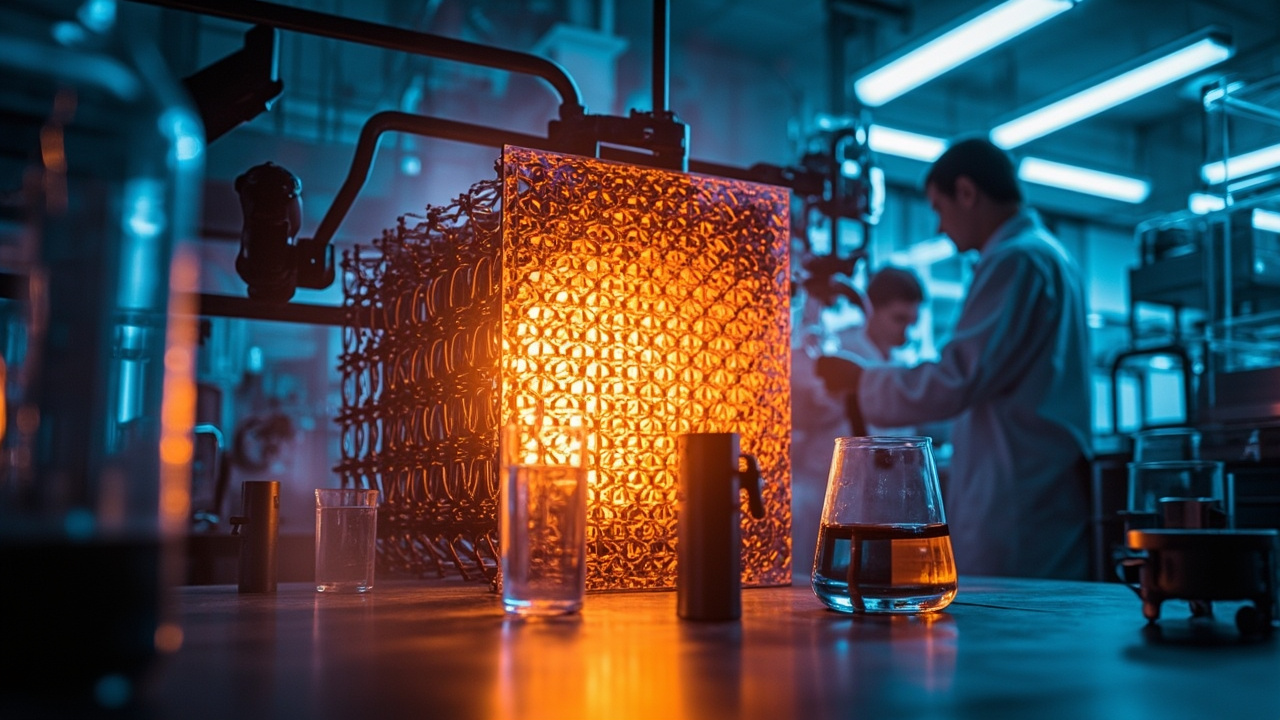
The researchers present metamaterial reactors that use high-frequency magnetic induction of axially tailored metamaterial baffles, according to the SUPER Lab abstract.
The purpose of that induction approach is to produce customized axial heating profiles.
The baffle consists of a combinatorial sequence of two types of lattices.
Each of the two lattice types has distinctive heating properties, according to the abstract.
The sequence of lattices can be inverse designed around the reaction engineering properties of the reactor.
The inverse design step is used to produce temperature profiles tailored for a given reaction.
The inverse design step is also described as producing temperature profiles tailored for a given flow condition.
The inverse design step is also described as producing temperature profiles tailored for a given maximum temperature.
In the team’s description, the heating profile is therefore selected around reaction, flow and maximum-temperature requirements rather than applied as one fixed field.
What was tested in flowing reactors
The team used the metamaterial reactors to enhance temperature uniformity in a set of packed bed flow reactors, according to the SUPER Lab abstract.
Each packed bed flow reactor in that set drove the reverse water gas shift reaction.
Each packed bed flow reactor was operated under different maximum temperature and flow conditions, according to the abstract.
The comparison in the tests was against uniformly heated systems.
The reported result was systematic increases in conversion compared with uniformly heated systems.
The abstract describes the uniformity improvement as the mechanism examined in those reverse water gas shift tests.
A National Laboratory of the Rockies presentation record for work presented at the 8th International Conference on Chemical Looping describes the reverse water-gas shift reaction as using hydrogen and carbon dioxide as the feed and reacting to produce syngas.
That same conference record describes syngas as a mixture of H2 and CO at a specific ratio.
That same conference record describes syngas as a useful precursor that can be converted into fuels and chemicals via known downstream processes, such as Fischer-Tropsch synthesis.
That same conference record states that the reverse water-gas shift reaction poses challenges due to restrictive thermodynamics.
That same conference record states that being an equimolar reaction, high temperatures and a large excess of H2 are needed to achieve reasonable CO2 conversion at equilibrium in that pathway.
Why temperature shape matters for conversion
The Stanford abstract positions temperature uniformity as a lever for higher conversion in packed bed flow reactors.
The Stanford tests varied maximum temperature across the reactor set.
The Stanford tests varied flow conditions across the reactor set.
The Stanford design approach varied the lattice sequence to match those operating points.
The use of two lattice types with distinctive heating properties gave the team a combinatorial way to adjust heating along the axis.
The inverse design framing means the baffle order follows from reactor requirements stated for reaction, flow and maximum temperature.
The reported outcome was not limited to one operating point, because the abstract reports systematic increases across the tested set.
The comparator throughout that statement is uniformly heated systems performing the same reverse water gas shift duty.
Electric heat in a wider industrial context
A separate September 3, 2026 report from ISPT titled "E-Missi0n: a key link in the development of emission-free e-furnace technology" describes a parallel electrification effort in chemicals.
That ISPT report states that the e-Missi0n MOOI project was a collaboration between Shell, Dow, TNO and ISPT.
The stated aim of e-Missi0n was an emission-free cracking process that runs on renewable energy, is more energy-efficient, consumes no fuel and produces more valuable raw materials.
The ISPT report states that steam cracking is used to produce basic chemicals that form the basis for plastics, latex and synthetic rubber, among other things.
The ISPT report states that steam cracking currently relies heavily on fossil fuels and is a prominent source of carbon emissions.
The ISPT report states that the e-Missi0n project investigated how this energy-intensive process can be electrified to reduce CO2 emissions in the chemical industry.
Conventional steam crackers generate heat by burning fuel, according to the ISPT report.
Replacing combustion with electrical energy eliminates the direct CO2 emissions, according to the ISPT report.
Replacing combustion with electrical energy also greatly enhances the integrated energy efficiency of the process, according to the ISPT report.
The ISPT report states that electrical furnaces do not produce flue-gas and the associated heat energy.
The ISPT report states that the absence of flue-gas offers the potential for significant improvements in overall energy efficiency.
Two routes tested for electric furnaces
Within e-Missi0n, three concepts were investigated in parallel: indirect electric heating, direct electric heating and a new reactor design, according to the ISPT report.
Those three concepts fall under two broader electrification routes described as the Brownfield route and the Novel route.
The Brownfield route involves retrofitting existing furnaces with electric heating elements, according to the ISPT report.
The Novel route involves the direct electrical heating of reactor coils, according to the ISPT report.
All three reactor designs were tested at a small scale, according to the ISPT report.
The ISPT report states that the steam cracking process essentially involves extracting hydrogen from the feedstock.
The ISPT report states that some of the valuable hydrogen is used to remove impurities.
The ISPT report states that a significant quantity is currently burned directly as fuel, alongside the produced methane, to keep the process running.
Electrification changes the use of by-products, offering the opportunity to use by-products as feedstock instead of as fuel, according to the ISPT report.
That shift makes the steam cracking process more energy-efficient without any economic disadvantage, according to the ISPT report.
The ISPT description states that less energy is required and more valuable products are produced under that electrified arrangement.
Heat recovery and readiness findings
The ISPT report states that innovative heat integration concepts for the electrification routes were developed based on molten salts.
That molten-salt work improves the recovery and reuse of heat from the process, according to the ISPT report.
The improved recovery and reuse enables more effective preheating of the feedstock, according to the ISPT report.
The ISPT project reported progress toward higher Technology Readiness Levels for all investigated technology pathways.
The project delivered significant breakthroughs and provided a realistic insight into technical possibilities and limitations, according to the ISPT report.
The results demonstrate that electrification is technically feasible, according to the ISPT report.
The same results statement adds that electrification also requires a continuous reliable power supply and further upscaling.
The collaboration combined technology innovation with system integration, according to the ISPT report.
By bringing together the complementary expertise of Shell, Dow, TNO and ISPT, e-Missi0n accelerated the development of e-furnace technology, according to the ISPT report.
The ISPT report identifies viable pathways toward large-scale decarbonisation of the chemical sector as the purpose of that combined work.
The ISPT report notes that the project is co-funded with subsidy from the Topsector Energy by the Ministry of Economic Affairs and Climate Policy.
The ISPT report points readers to a public report with technical results and key insights from the project.
What remains tied to the Stanford result
The Stanford result is specific to packed bed flow reactors driving the reverse water gas shift reaction, according to the SUPER Lab abstract.
The Stanford result is specific to customized axial heating profiles produced by high-frequency magnetic induction.
The Stanford result is specific to axially tailored metamaterial baffles built from two lattice types.
The Stanford result is specific to sequences that can be inverse designed around reaction engineering properties.
The Stanford result is specific to temperature profiles tailored for a given reaction, flow condition and maximum temperature.
The Stanford conversion finding is stated as systematic increases versus uniformly heated systems across different maximum temperature and flow conditions.
The funding record ties the indexed Stanford paper to Shell United States and the U.S. Department of Energy.
The publication record ties the work to Science Advances and the SUPER Lab release dated September 4, 2026.
The conference record ties reverse water-gas-shift interest to syngas production from hydrogen and carbon dioxide for fuels and chemicals via Fischer-Tropsch synthesis.
The ISPT record ties broader electrified-heat interest to emission-free cracking, furnace retrofits, direct coil heating, molten-salt heat integration and higher Technology Readiness Levels.
Together, the SUPER Lab abstract, the indexed Science Advances record and the ISPT e-Missi0n report describe electrified heating as both a decarbonization route for high-grade heat and a design route for shaping temperature where reactions occur.
Sources referenced
- SUPER Lab - Electrified thermochemical reaction engineering with metamaterial reactors (https://superlab.stanford.edu/publication/2026-09-04-SciAdv-ElectrifiedThermochemicalReactionEngineering-MetamaterialReactors_Hofelmann/)
- E-Missi0n: a key link in the development of emission-free e-furnace technology – ISPT (https://ispt.eu/news/e-missi0n-a-key-link-in-the-development-of-emission-free-e-furnace-technology/)