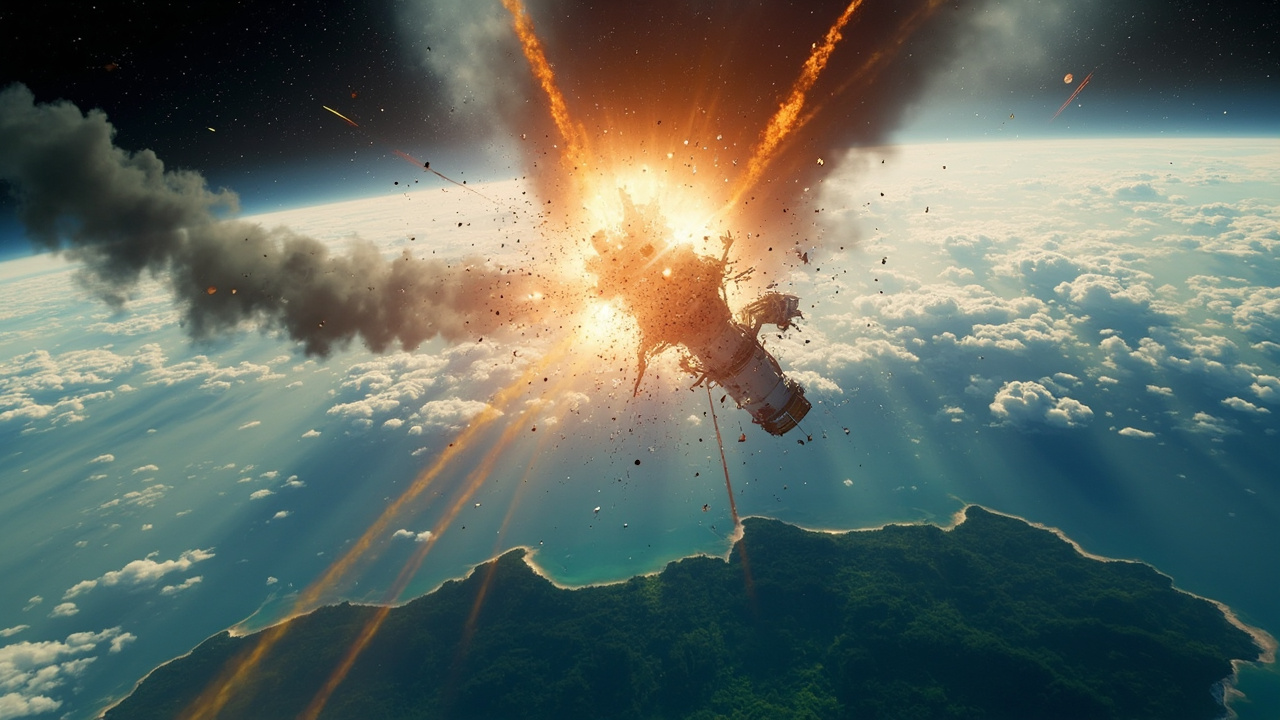
NASA's Neil Gehrels Swift Observatory re-entered Earth's atmosphere on November 4, 2026, burning up over the North Sumatra region of Indonesia at approximately 7:39 AM EST, closing out nearly 22 years of science that reshaped how astronomers study the universe's most violent explosions.
What Swift Did in 22 Years
Launched on November 20, 2004, Swift carried three coordinated instruments capable of detecting gamma-ray bursts (GRBs) and then pivoting rapidly to observe their afterglows across X-ray, ultraviolet, and optical wavelengths. That quick-turn capability was the mission's defining trait: when Swift spotted a burst, it could repoint within roughly 90 seconds and simultaneously alert ground-based observatories before the afterglow faded.
Over its operational lifetime, the spacecraft logged observations of more than 2,000 gamma-ray bursts and contributed to approximately 7,000 peer-reviewed research papers, according to NASA. Those figures place Swift among the most scientifically productive astrophysics missions ever flown, well exceeding its original design life of roughly two years.
Gamma-ray bursts are the brightest electromagnetic events known in the observable universe, produced by the collapse of massive stars or the merger of compact objects such as neutron stars. Before Swift, astronomers struggled to catch the brief optical and X-ray afterglows that follow the initial burst, which can fade within minutes. Swift's automated alert system changed that, enabling a global network of telescopes to respond in near-real time.
Shawn Domagal-Goldman, director of NASA's Astrophysics Division, was quoted by NASA as saying Swift "played a major role in advancing our understanding of the changing universe," pointing specifically to the observatory's rapid-response observations as a model for multi-wavelength astronomy.
Why the Observatory Came Down When It Did
Like all satellites in low Earth orbit, Swift experienced gradual altitude loss from atmospheric drag. By early 2026 it was clear the spacecraft, then operating well below its original orbital altitude, would re-enter within the year unless it received a propulsive boost.
In September 2026, NASA awarded Katalyst Space Technologies a $30 million contract to perform a robotic servicing mission. The company's spacecraft, called LINK, was designed to dock with Swift and push it to a higher, safer orbit that would have extended its operational life by several years. LINK launched on schedule but encountered propulsion problems after separating from its launch vehicle, according to reporting by The Verge, leaving it unable to reach Swift's orbital position. With no rescue possible, the telescope was left on its natural decay trajectory.
The failed servicing attempt highlighted a persistent challenge in satellite operations: even a mature, high-value spacecraft can be lost if an in-space logistics vehicle encounters a single-point failure. NASA has not publicly disclosed the specific nature of LINK's propulsion fault.
The Re-Entry Itself
As Swift's final descent approached, NASA's reentry predictions narrowed to an uncertainty window of roughly 11 hours, a typical constraint given the difficulty of modeling upper-atmosphere density variations. Officials estimated a 1-in-2,100 probability that any surviving debris would injure someone on the ground — a figure well within accepted spaceflight risk guidelines.
The spacecraft crossed over the North Sumatra region of Indonesia at 7:39 AM EST on November 4, 2026, and no injuries or property damage were reported in the aftermath, according to NASA. Because Swift was not designed with controlled deorbit capability, the precise debris footprint was not known in advance; most of the structure burned during hypersonic entry.
The re-entry brought renewed attention to the growing challenge of decommissioning aging satellites responsibly. Swift was designed in the late 1990s, before international guidelines for end-of-life disposal had matured. Modern missions are increasingly required to include propellant reserves or design features that allow a controlled, targeted re-entry over ocean corridors.
What the Science Legacy Means Going Forward
Swift's archive of GRB data continues to be mined by researchers. The observatory's observations contributed to some of the first electromagnetic counterparts detected alongside gravitational-wave events, linking it directly to the emerging field of multi-messenger astronomy. Its X-ray telescope also catalogued hundreds of thousands of X-ray sources beyond its GRB primary mission, providing a legacy dataset that remains publicly available through the High Energy Astrophysics Science Archive Research Center.
The mission also demonstrated that relatively small, agile spacecraft — Swift weighed about 1,470 kilograms at launch — can produce outsized science returns when equipped with automated alert systems. That design philosophy has influenced subsequent missions, including those studying fast radio bursts and X-ray transients.
NASA has not announced a direct Swift successor, but several proposed missions and international instruments are designed to continue GRB monitoring with improved sensitivity. The gap left by Swift's loss is expected to be partially filled by existing assets such as the Fermi Gamma-ray Space Telescope, though Fermi lacks Swift's rapid X-ray follow-up capability.
The Broader Challenge of Aging Space Infrastructure
Swift's story is not unique. A growing number of NASA and international science satellites launched in the late 1990s and early 2000s are approaching or past their design lives, operating on dwindling fuel reserves or degraded hardware. The Swift servicing attempt by Katalyst Space Technologies was one of the first commercial contracts aimed specifically at life-extension for a science mission rather than a commercial communications satellite.
According to The Verge's coverage of the LINK mission, the $30 million contract represented a relatively modest investment compared to the cost of building and launching a replacement spacecraft, which for a mission of Swift's complexity would likely run into the hundreds of millions of dollars. The commercial in-space servicing sector has pointed to this cost asymmetry as a central argument for investing in rendezvous and docking technologies.
The LINK failure does not necessarily discredit the broader servicing concept, but it does illustrate that the technology remains in an early, higher-risk phase. Northrop Grumman's Mission Extension Vehicle program has demonstrated successful commercial satellite life extension in geostationary orbit, but low-Earth orbit servicing — where orbital mechanics are more demanding and debris avoidance more complex — presents additional engineering hurdles.
Swift's Numbers at a Glance
To summarize the mission's scope: Swift operated for approximately 22 years against a planned mission life of roughly two years, observed more than 2,000 gamma-ray bursts, and underpinned about 7,000 scientific publications. It carried three instruments — the Burst Alert Telescope, the X-Ray Telescope, and the UV/Optical Telescope — allowing it to respond across a wide swath of the electromagnetic spectrum from a single platform.
That combination of breadth and speed made Swift a uniquely versatile tool. Astronomers used it not only for GRBs but for supernovae, active galactic nuclei, magnetars, tidal disruption events, and, in its later years, the electromagnetic counterparts to gravitational-wave detections.
The observatory's formal name honors Neil Gehrels, the NASA astrophysicist who served as Swift's principal investigator from its inception through its early operational years and who died in 2017. Renaming the mission in his honor was a recognition of his central role in its design and advocacy.
With Swift gone, the astrophysics community loses one of the fastest-responding space observatories ever built — a 1,470-kilogram spacecraft that managed, over more than two decades, to catch light from some of the most distant events in the observable universe.
Sources referenced
- NASA's Swift Gamma-Ray Burst Mission — NASA (https://www.nasa.gov/mission/neil-gehrels-swift-observatory/)
- Swift Observatory reentry: NASA's gamma-ray telescope burns up over Indonesia — The Verge (https://www.theverge.com/2026/11/4/swift-observatory-reentry-nasa)