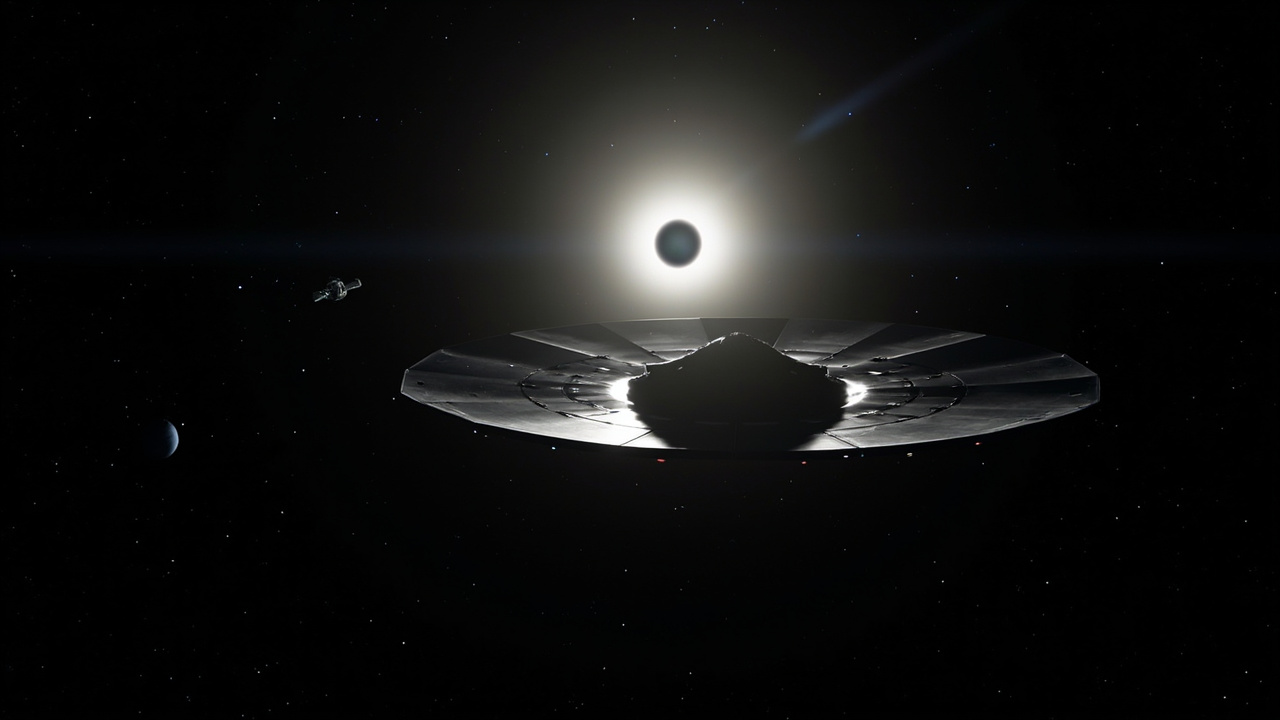
Astronomers can now simulate exactly how a flower-shaped spacecraft blocks a star's blinding glare, thanks to an open-source Python library called SISTER — the Starshade Imaging Simulation Toolkit for Exoplanet Reconnaissance — developed as part of NASA's active starshade research program.
Why Starlight Is the Enemy of Exoplanet Science
Directly photographing a planet orbiting a distant star is one of the hardest problems in modern astronomy. The core difficulty is contrast: a star pours out so much light that the faint reflected glow from any orbiting planet is completely buried in the glare. The gap in brightness is so extreme that detecting a planet next to its star has been compared to picking out a single candle flame burning a few feet from a stadium's worth of floodlights — both objects in the same field of view, the candle essentially invisible.
The traditional hardware fix for this problem is a coronagraph, a device built into the telescope that uses masks and optics to suppress the central starlight. Coronagraphs have made real progress over the past two decades, but they face a stubborn obstacle: tiny manufacturing imperfections and mechanical vibrations inside the telescope generate their own optical noise, limiting just how dark the coronagraph can make the region around the star. For the goal of imaging rocky, Earth-sized planets in the habitable zones of nearby stars, that residual noise remains too bright.
What a Starshade Actually Does
A starshade is a separate spacecraft, launched independently of its paired telescope, that flies thousands of miles in front of the observatory and physically intercepts the starlight before it ever enters the telescope. The device takes the form of a large disk with precisely shaped petal edges — the petal geometry is not decorative but mathematically calculated so that the edges scatter and cancel diffracted starlight with high precision, casting an extremely dark shadow directly onto the telescope's primary mirror.
By handling suppression externally rather than inside the telescope, a starshade sidesteps the main weakness of coronagraphs: internal optical imperfections simply stop mattering because the offending light is already gone before it enters the instrument. The tradeoff is operational complexity. The starshade and the telescope must fly in precise formation, separated by tens of thousands of kilometers, with the starshade kept aligned to within meters of the exact line of sight between the telescope and the target star.
According to NASA's Exoplanet Exploration Program documentation, starshade concepts are being actively developed for potential use alongside the Nancy Grace Roman Space Telescope and the proposed Habitable Worlds Observatory (HWO), the large infrared-optical-ultraviolet space telescope recommended by the Astro2020 Decadal Survey.
NASA's S5 Program and the Push for TRL5
Funding and direction for this technology sits inside NASA's Starshade Technology Development Activity, known internally as S5. The program's explicit goal is to mature starshade hardware and techniques to Technology Readiness Level 5 — the milestone that means a technology has been validated in a relevant environment and is credibly on track for mission adoption.
S5 targets three distinct technical areas. The first is starlight suppression itself: demonstrating that the shaped petal edges can block stellar photons to the depth required. The second is formation sensing and control, meaning the navigation and positioning systems that keep the two spacecraft aligned precisely enough that the shadow falls where it must. The third is deployment accuracy — confirming that a starshade stowed for launch can unfurl in space and reach its intended shape within tolerances tight enough to preserve the suppression performance.
Each of these areas involves both hardware experiments and software modeling, and it is on the software side that the SISTER toolkit has emerged as a particularly valuable contribution, according to material published through NASA's science programs.
Inside the SISTER Toolkit
SISTER is an open-source Python library designed so that research teams anywhere can run high-fidelity simulations of what a starshade-equipped telescope would actually see. Rather than relying on simplified approximations, the toolkit uses a numerical approach built around the Bluestein Fast Fourier Transform to simulate the propagation of light from a star, through or around the starshade, and onto the telescope's detector.
That diffraction-simulation capability is central to predicting how much starlight leaks past the petal edges under real operating conditions — a number that determines whether a given planet signal can be detected above the background. SISTER outputs what researchers call optical throughput: the fraction of an exoplanet's light that actually reaches the detector, which must be maximized, alongside the residual stellar leak, which must be minimized.
Beyond simple suppression modeling, SISTER provides comprehensive optical performance modeling across a wide range of observational parameters. A research team can feed in details of a specific target star system — its distance, the star's brightness, the suspected orbital geometry of a planet — and the toolkit will generate simulated images reflecting those conditions. This matters practically because different mission profiles and different target systems impose different demands on the starshade's performance.
One particularly useful demonstration of SISTER's reach is its ability to simulate solar-system analogs at various orbital inclinations. Because most exoplanetary systems will not be viewed perfectly face-on or edge-on, astronomers need to know how starshade imaging performs across a spectrum of viewing geometries. SISTER's simulations cover that range, allowing mission planners to identify which target systems are most favorable for follow-up observation and to design observing strategies accordingly.
The open-source, Python-based architecture of the toolkit is a deliberate choice. It means that university groups, independent researchers, and NASA centers alike can run the same simulations, check each other's assumptions, and extend the codebase as new starshade designs or telescope specifications are proposed.
Formation Flying: The Hardest Engineering Problem
Of the three S5 technical areas, formation sensing and control is in some respects the most demanding, because it has no meaningful analog in earlier space missions. Keeping two separate spacecraft aligned to sub-meter precision across a separation of tens of thousands of kilometers requires sensor systems capable of detecting tiny relative drifts and propulsion systems precise enough to correct them continuously without exhausting fuel.
Software plays a central role here as well. Navigation algorithms must distinguish genuine formation drift from sensor noise, calculate correction burns efficiently, and manage the tradeoff between position accuracy and propellant consumption over what could be a multi-year mission. The simulation capabilities developed in programs like S5 feed directly into validating those algorithms before hardware ever reaches space.
Deployment accuracy rounds out the challenge. A starshade would launch tightly folded inside a rocket fairing and unfurl in orbit. The petal geometry that produces precise diffraction cancellation must be reproduced after deployment to tolerances of fractions of a millimeter across a structure that could span tens of meters. Ground tests and modeling work, both part of S5's scope, aim to prove that this is achievable.
What Better Software Means for Finding Earth Twins
The science case driving all of this engineering effort is the detection and characterization of Earth-like planets — rocky worlds roughly the size of our own, orbiting in the habitable zones of Sun-like stars close enough to study. Those targets are the most demanding possible: faint, close to bright stars, requiring both high contrast suppression and adequate light collection to analyze the planet's reflected spectrum.
Improved simulation tools accelerate this goal in two ways. First, they allow engineers to identify design weaknesses and fix them before building flight hardware, compressing development timelines and reducing costs. Second, they let astronomers pre-select which of the hundreds of candidate nearby star systems would yield the most scientifically valuable observations, making the eventual mission more efficient.
SISTER's ability to model realistic imaging scenarios for solar-system analogs at varied inclinations means that mission planners for both the Roman Space Telescope starshade option and the proposed Habitable Worlds Observatory can now run evidence-based target selection rather than relying on cruder estimates. Each improvement in simulation fidelity narrows the gap between promising concept and operational instrument.
According to NASA's Exoplanet Exploration Program, the combination of starshade hardware maturation under S5 and software tools like SISTER represents a coordinated pathway toward the first direct images of planets that could, in principle, support life. That is not a guarantee of discovery — it is an engineering foundation being carefully assembled, one software release and one laboratory test at a time.
Ars Technica covered the broader software push in its science section, noting that getting software to reliably model starlight suppression is a prerequisite step for translating starshade concepts into a funded, buildable mission.
Sources referenced
- NASA Exoplanet Exploration: Starshade Technology Development (https://science.nasa.gov/astrophysics/programs/exep/technology/starshade/)
- Ars Technica: Getting software to help block out a star so we can see exoplanets (https://arstechnica.com/science/2026/11/getting-software-to-help-block-out-a-star-so-we-can-see-exoplanets/)